Direct and indirect prompt injection
Test instruction conflicts, untrusted retrieved content, uploaded documents, websites, tool output, encoded payloads, multi-turn persistence, and attempts to override policy or system goals.

Adversarial security testing for AI applications, chatbots, RAG systems, autonomous agents, tool use, and Model Context Protocol integrations.
EXPERT-LED · MANUAL VALIDATION
The model is only one part of an AI system. Real risk emerges where prompts, retrieved data, identities, tools, memory, plugins, MCP servers, and downstream actions meet. Testing follows those connections to validate data leakage, unsafe agency, and cross-user impact.
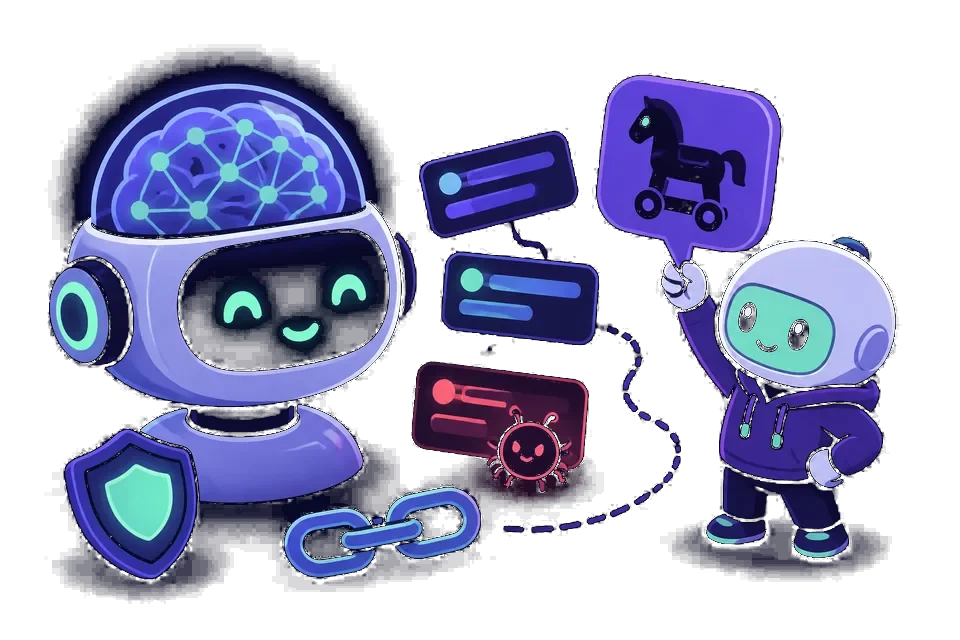
HOW THE TESTING FEELS IN PRACTICE
Automation gives coverage. The findings that matter come from someone chaining weak controls together, questioning assumptions, and checking what a motivated attacker could reach next.
ASSESSMENT COVERAGE
Coverage is finalized during scoping, then tested with a mix of systematic checks and manual attack-path analysis.
Test instruction conflicts, untrusted retrieved content, uploaded documents, websites, tool output, encoded payloads, multi-turn persistence, and attempts to override policy or system goals.
Assess retrieval authorization, tenant filters, chunk metadata, embeddings, citations, indexing pipelines, stale access, deleted content, and whether one user can influence or retrieve another user's data.
Challenge tool selection, parameter validation, permission scope, confirmation boundaries, action chaining, irreversible operations, identity propagation, and whether model output is treated as trusted instructions.
Review server trust, tool descriptions, transport and authentication, confused deputy paths, prompt-bearing resources, poisoned tools, token exposure, local execution, and cross-server context leakage.
Test system prompt leakage, secrets in context, training or indexed data exposure, verbose traces, conversation history, logs, model provider boundaries, and output sanitization.
Validate conventional authorization, session, upload, SSRF, injection, rate-limit, abuse, and business logic controls around the AI feature rather than attributing every weakness to the model.
RULES OF ENGAGEMENT FIRST
Every phase is designed to produce defensible evidence without taking unnecessary operational risk.
Agree targets, environments, identities, exclusions, test windows, data handling, escalation contacts, and stop conditions before testing starts.
Map sensitive assets, trust boundaries, data flows, likely attackers, and high-impact misuse cases so the test reflects the product rather than a generic checklist.
Use repeatable tooling and standards-aligned checks to cover the agreed surface while recording assumptions, constraints, and evidence.
Challenge identity, authorization, workflows, configuration, integrations, and chained weaknesses that require human context and adversarial reasoning.
Use the minimum proof required to establish exploitability. Destructive actions, persistence, and unnecessary data access stay outside scope unless separately authorized.
Deliver risk context, reproduction evidence, root-cause fixes, and a stakeholder walkthrough. One retest round verifies agreed remediation.
ACTIONABLE OUTPUTS
The report is written for two audiences: stakeholders who need a clear risk decision and engineers who need enough detail to reproduce and fix the issue.
KEEP REVIEWING YOUR CONTROLS
COMMON SCOPING QUESTIONS
No. Prompt injection is one path. Testing also covers authorization, RAG isolation, sensitive data, tool permissions, excessive agency, MCP integrations, output handling, and conventional application security.
Yes. The rules of engagement define safe test accounts, approval gates, reversible actions, and kill conditions before any agentic workflow is exercised.
Yes. MCP authentication, transport, tool and resource trust, local execution, secret exposure, confused deputy risks, and cross-server context handling can be scoped.
No. The deliverable is an evidence-based security assessment of the scoped system. It does not claim that a probabilistic model is permanently safe or compliant.
CLEAR SCOPE · CONTROLLED TESTING · USEFUL REPORT
Share the target, environment, roles, and objective. The service field is already selected so you can send the right context quickly.
TELL US ABOUT YOUR SCOPE
Share a few details about the target and your goals. We will reply with the right testing approach and a clear proposal.
Protected against automated submissions. Only submit systems you own or are authorized to test. Do not include passwords, API keys, or other secrets.