
When news broke that Binance suffered a coordinated $6.3 billion multi-chain drain in under twenty minutes, the security community immediately pivoted to its familiar post-incident rituals: blockchain intelligence firms mapped transaction hops, federal agencies attributed the campaign to North Korea's TraderTraitor group, and social feeds debated the exact dollar amount lost.
For Product Security and Application Security engineers, however, these forensic postmortems leave the most vital questions unanswered. Knowing which threat actor sent which trojanized npm package over LinkedIn explains how a developer got compromised, but it does nothing to explain why a single compromised machine had a direct operational path to drain institutional hot wallets across ten distinct blockchains.
The elliptic curve cryptography never broke. No private keys were extracted. What failed was the entire chain of trust: the assumption that internal service containers can be trusted implicitly, the blind execution of raw byte payloads by hot wallet signers, and the complete absence of semantic policy validation. This post is an engineering breakdown of that architectural collapse, what the public discourse is missing, and how a resilient Product Security program prevents it.

The Core Failure: When Cryptography Outlives Authorization
In corporate postmortems and mainstream reporting, breaches like this are routinely described as "hot wallet hacks." That phrase is a misnomer that obscures the real problem.
A hot wallet is essentially a private key residing in memory or an online hardware module, available to sign transactions on demand. The key is just math. The security of a hot wallet does not depend on the math; it depends on the authorization policy governing who can invoke that math and under what conditions.
In Binance's case, the attackers compromised the authority layer, not the key layer. By chaining an infected employee endpoint to an internal service container, they gained access to the signing pipeline. Once inside, they commanded the signing infrastructure to produce valid signatures for malicious payloads. The signing system complied because it evaluated caller identity rather than transaction intent. It asked "Is this request from an authorized internal service?" instead of asking "Is this service permitted to delegate wallet execution to an arbitrary smart contract and drain sixty asset classes in twenty minutes?"
The distinction is profound. If your signing pipeline accepts raw byte arrays from any service inside your cluster and signs them without semantic inspection, your security perimeter is not your cryptographic key management-it is whatever fragile developer endpoint sits on the other end of that RPC connection.
The Five Stages of the Intrusion
Reconstructing the kill chain across Binance disclosures, FBI advisories, and on-chain traces reveals five distinct operational phases:
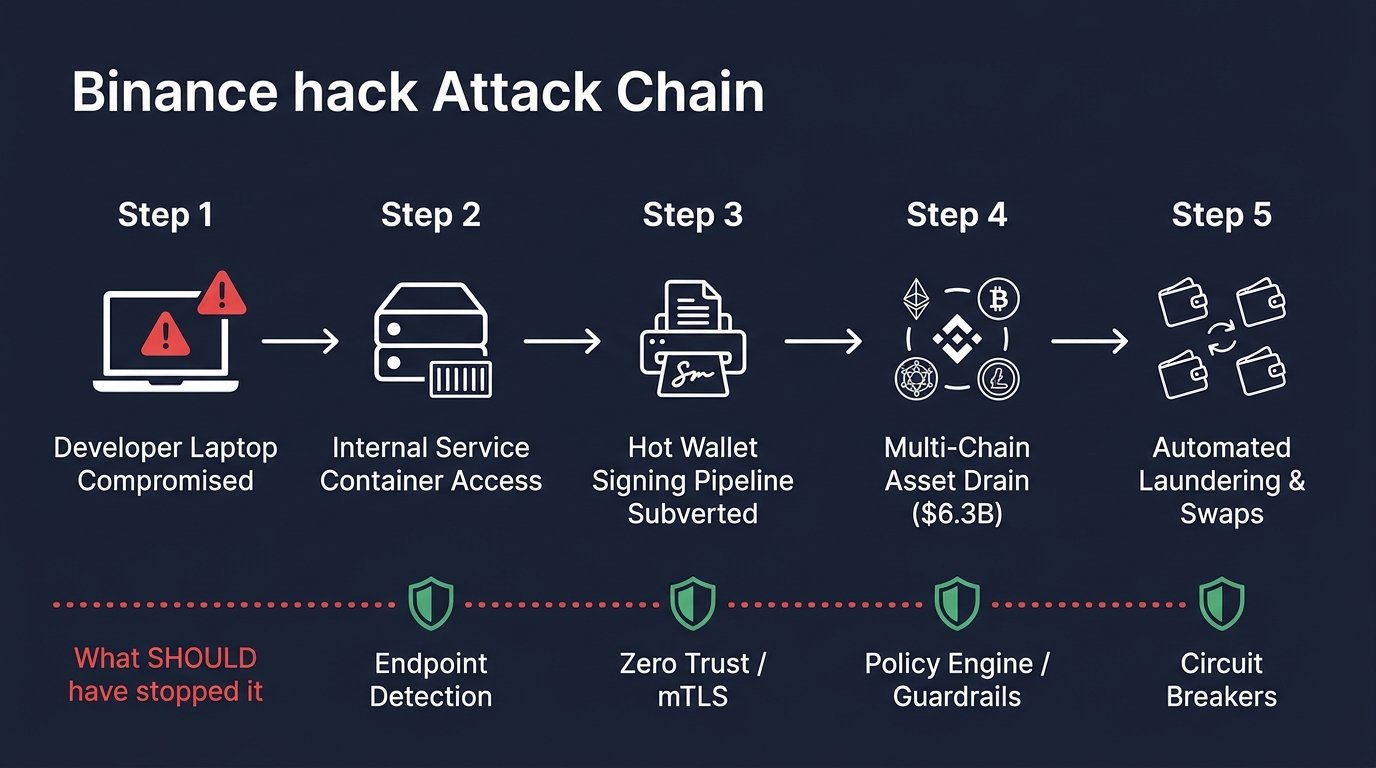
Stage 1: The Developer Machine as an Initial Access Vector
The breach began on a DevOps engineer's corporate workstation. North Korea's TraderTraitor operators have spent years perfecting social engineering campaigns against cryptocurrency personnel. Their playbook relies on synthetic LinkedIn recruiter profiles, high-compensation employment pitches, and technical coding tests containing trojanized dependencies (typically backdoored npm packages or Python scripts).
Once executed, the malware installed persistent backdoors with automated anti-forensic capabilities designed to wipe execution traces after operation completion. In a standard corporate setup, engineering laptops frequently hold long-lived cloud credentials, Docker registry secrets, SSH keys to jump hosts, and VPN tunnels into internal staging and production meshes. The workstation was never designed to be the security perimeter, yet it held the keys to enter it.
TraderTraitor ran almost this exact opening gambit against Bybit in February 2025, compromising developer machines at Safe ecosystem wallet partners to siphon $1.5 billion. The Binance attack was not an unknown vector; it was the identical playbook executed at five times the scale.
Stage 2: Lateral Movement and the Fallacy of Network Boundaries
With initial access secured on the workstation, the attackers pivoted into an internal service container that possessed permissions to submit withdrawal requests to the hot wallet backend. In modern cloud architectures, this hop is shockingly easy if network segmentation is loose: a developer machine connects to a bastion or Kubernetes cluster via an active session, inherits the service account permissions of a deployment container, and suddenly possesses internal network reachability to administrative APIs.
Binance noted in subsequent communications that the intrusion "went beyond a single device," indicating the attackers moved deliberately through secondary internal vectors to position themselves simultaneously across multiple blockchain gateways before initiating the actual sweep.
Stage 3: Subverting the Signing Gateway (The Blind Rubber Stamp)
This was the fatal architectural bottleneck. The signing service treated upstream service containers as fully trusted entities. When the compromised container submitted batch transaction requests, the signer performed cryptographic checks on the request token, verified that the caller originated from an approved internal IP block, and generated valid ECDSA/EdDSA signatures on the requested payloads.
What the signing service completely failed to do was inspect the semantics of what it was signing. It treated a request to delegate full wallet execution code the same way it treated an ordinary 10 USDT customer withdrawal. It functioned as a cryptographic rubber stamp rather than an intelligent policy enforcement point.
Stage 4: The Weaponization of EIP-7702 (Technical Deep Dive)
The Ethereum phase of the attack represents one of the most sophisticated on-chain maneuvers observed in the wild, exploiting a capability introduced in Ethereum's Pectra upgrade: EIP-7702.
EIP-7702 was designed to bring smart-contract account abstraction capabilities to regular Externally Owned Accounts (EOAs) by allowing an EOA to designate bytecode that temporarily dictates its execution logic. In the hands of an attacker with signing access, this feature became a devastating atomic weapon:
- Deploying the Sweeper Bytecode: The attackers deployed an on-chain contract specifically written to liquidate all native ETH and enumerate over sixty ERC-20 token balances, routing them directly to attacker-controlled recipient addresses in a single function call.
- The 50-Nonce Spray: Binance's primary operational hot wallet ("Binance 14") was under constant transaction load, processing customer withdrawals with its nonce incrementing 10 to 11 times per minute. To ensure execution without colliding with live traffic, the attacker forced the signing backend to sign fifty consecutive EIP-7702 authorization payloads, spanning nonces sequentially starting at approximately 18,914,775. This guaranteed that the moment one authorization hit the mempool, it would bind perfectly to the wallet's current on-chain state.
- Contract Code Takeover: Once the valid authorization was confirmed, Binance 14's runtime code was dynamically reassigned to the attacker's sweeper contract. The institutional hot wallet ceased to be a simple keypair; it became an autonomous draining program.
- The Atomic Sweep: In a single block transaction, the contract swept 167,464 ETH alongside approximately $1.615 billion in Tether (USDT) and dozens of secondary tokens. The entire treasury was evacuated without requiring individual withdrawal signatures for each asset.
- Passive Siphon Persistence: Because the EIP-7702 delegation remained active on-chain, incoming customer deposits and automated treasury balancing transfers continued to be siphoned directly to the attacker for roughly 3 hours and 50 minutes until Binance engineers successfully broadcast a revocation transaction.
Stage 5: Multi-Chain Parallel Extraction and Laundering
While the Ethereum sweep unfolded, automated bots simultaneously triggered mass outflows across nine additional blockchains: Bitcoin, Tron, Solana, Avalanche, XRP Ledger, Polygon, and others. Within twenty minutes (commencing at approximately 20:05 UTC), over $6.3 billion had exited Binance control.
The laundering phase kicked off immediately. Attackers executed programmatic swaps converting freeze-prone stablecoins (USDT, USDC) into native assets (ETH, BTC) via decentralized liquidity pools before central issuers could blacklist addresses. Stolen tokens were deposited as collateral into lending protocols like Aave to borrow unencumbered assets, while secondary volumes were dispersed through cross-chain bridges and dusting networks to fragment transaction graphs.
The Architectural Antidote: How Product Security Solves This
Security failures of this magnitude are never the fault of a single bad click. They occur when an organization's defense-in-depth architecture collapses into a series of single points of failure. Here is how a battle-tested Product Security program designs these systems so that a compromised laptop never reaches the treasury.
1. Hardened Developer Workstations: Eliminating Standing Privileges
DevOps and infrastructure engineers are high-value targets. Treating their laptops as trusted production portals is an architectural flaw. Product Security must enforce structural isolation:
- Zero Standing Credentials: Developer machines must not store long-lived API tokens, SSH keys, or cloud access keys. All access should require ephemeral, hardware-backed authentication (WebAuthn/FIDO2) mediated by just-in-time privilege brokers with automated expirations measured in hours, not months.
- Isolated Jump Hosts for Production Operations: High-risk tasks-such as modifying signing services, adjusting custody policies, or deploying container images-must occur within locked-down, ephemeral Virtual Desktop Infrastructure (VDI) or dedicated privileged access workstations (PAWs) stripped of external internet browsing and email.
- Continuous Posture Attestation: Zero-Trust Network Access (ZTNA) solutions must verify active EDR telemetry, patch compliance, and kernel integrity on every network hop. An endpoint demonstrating anomalous process spawns or memory injection must have its sessions instantly terminated across all identity providers.
2. Cryptographic Workload Identity: Killing Implicit Container Trust
The attacker's ability to pivot from a workstation into a service container and immediately communicate with the signing infrastructure highlights a failure of service-to-service authentication:
- SPIFFE/SPIRE Implementation: Workloads must authenticate using cryptographically verifiable identity documents (SVIDs) backed by hardware attestation (such as TPMs or AWS Nitro Enclaves), rather than relying on network location or cluster-internal DNS.
- Strict mTLS Enforcement: Every microservice boundary must mandate bidirectional TLS. An ad-hoc shell inside a compromised container cannot simply fire curl requests at an internal endpoint if it lacks the short-lived client certificate bound to that specific microservice's identity.
- Hard Network Micro-Segmentation: Hot wallet signing services must reside in isolated virtual private clouds with strictly whitelisted egress and ingress. No developer workstation or standard staging container should ever possess network-level routing to a signing socket.
3. The Semantic Policy Firewall: Never Sign What You Cannot Understand
This is the single most critical engineering takeaway from the entire incident: signing infrastructure must possess semantic understanding of the transactions it authorizes.
A dumb signing service that takes an arbitrary byte payload and signs it because the API token was valid is a disaster waiting to happen. An independent policy engine (guardrails gateway) must sit directly in front of the key enclaves, enforcing strict invariants:
- Transaction Type Whitelisting: A customer withdrawal hot wallet should only sign simple balance transfers to recipient addresses. Any transaction attempting contract deployment, delegatecall invocation, or EIP-7702 code delegation must be rejected automatically at the gateway level.
- Destination Whitelisting and Delay Queues: Outflows to unvetted smart contracts or novel addresses exceeding defined thresholds must trigger mandatory time delays and multi-party human verification.
- Payload Decoding and AST Validation: The guardrails layer must decompile and parse the transaction Abstract Syntax Tree (AST). If the payload contains logic to iterate through token lists or alter wallet execution code, the signature request must be dropped with a high-severity security incident alert.
4. Autonomous In-Band Circuit Breakers
Binance lost $6.3 billion across ten chains in twenty minutes. In any mature financial engineering environment, systemic velocity limits must halt execution long before losses reach nine figures:
- Signing-Layer Rate Limiting: Velocity limits must be enforced inside the signing service itself, not in the web application. If the application server is compromised, application-level rate limits are simply bypassed. The signer must track cumulative outflow per asset over 5-minute, 1-hour, and 24-hour rolling windows.
- Cross-Chain Anomaly Correlators: When sudden, massive outflows occur across Ethereum, Bitcoin, Solana, and Avalanche simultaneously, an automated global circuit breaker must instantly engage, freezing automated signing across all chains until multi-party executive sign-off is completed via hardware keys.
- Independent Balance Auditing: An out-of-band monitoring daemon, completely separated from the trading and withdrawal infrastructure, must monitor hot wallet balances directly from public nodes. If a wallet's reserves plummet by more than 20% in an hour, it must trigger automated kill switches that revoke network connectivity to the signing enclaves.
5. Threshold MPC with Invariant Policy Enclaves
Relying on a single internal service to authorize key usage defeats the entire premise of multi-party computation:
- Geographically and Environmentally Isolated Shards: Threshold signature schemes (such as 3-of-5 MPC) must distribute key shares across distinct cloud vendors, on-premises HSMs, and isolated organizational units. Compromising one service container should grant access to at most one share, making valid signature generation mathematically impossible.
- Independent Node Policy Validation: Every individual MPC node must run its own independent policy engine before releasing its signature share. If Node A's policy engine flags an EIP-7702 delegation as unauthorized, it refuses to participate in the signing quorum, preventing the full signature from ever being assembled.
The Bybit Precedent: Why This Was an Unlearned Lesson
What frustrates security professionals about the Binance breach is that the blueprint was handed to the industry eight months earlier. In February 2025, Bybit suffered a $1.5 billion theft executed by the same threat actors using the same operational thesis:
- Bybit: Infiltrated developer endpoints at an external custody ecosystem partner -> manipulated transaction-signing interfaces -> coerced signing infrastructure into authorizing malicious transfers.
- Binance: Infiltrated DevOps engineer workstation -> pivoted to internal container -> coerced hot wallet pipeline into signing unauthorized mass withdrawals and EIP-7702 sweeper delegations.
The difference was purely one of scale and technical execution. The structural vulnerability-a soft engineering endpoint connected to a dumb signing pipeline without in-band semantic checks-was identical. Every exchange architect who reviewed the Bybit postmortem should have immediately conducted an internal red-team exercise: "If an adversary controls a DevOps laptop right now, can they induce our signing backend to sign an unauthorized transaction?" For Binance, the answer was yes.
What Other Analyses Get Right - and Where the Discourse Is Blind
A comprehensive review of existing technical coverage across vendors and newsrooms highlights clear strengths alongside major analytical blind spots:
Where the Coverage Shines
- On-Chain Tracing (TRM Labs, Chainalysis): Outstanding forensic work documenting fund hops, DEX routing, stablecoin blacklisting timelines, and bridge activity. Invaluable for law enforcement and recovery operations.
- Cryptographic Protocol Forensics (Elliptic): Early, rigorous deconstruction of the EIP-7702 nonce spray mechanics and sweeper delegation behavior on Ethereum.
- Custody Best Practices (Halborn, Fireblocks): Sound architectural recommendations regarding HSM integration, MPC quorum policies, and institutional signing controls.
Where the Coverage Falls Short
- Treating the Hack as an On-Chain Vulnerability: Many write-ups frame the incident around EIP-7702 as if the Ethereum standard itself was defective. EIP-7702 performed exactly as specified. The vulnerability was that an internal corporate pipeline authorized an EIP-7702 transaction for an institutional hot wallet that had zero business executing account delegations.
- Ignoring the ProdSec Governance Gap: Little attention has been paid to the failure of threat modeling. When Ethereum Pectra testnets went live, did Product Security update their threat matrices to evaluate how EIP-7702 delegation signatures would interact with their hot wallet signing services? Clearly not.
- Over-Indexing on Initial Access: Fixating on fake LinkedIn recruiters misses the forest for the trees. Phishing will always succeed eventually. The failure occurred when the blast radius of that compromised laptop was allowed to encompass the multi-billion-dollar treasury.
The ProdSec Action Plan: What Engineering Teams Should Audit Tomorrow
If you are responsible for securing high-value transaction pipelines, here is the concrete implementation roadmap derived from this incident:
Immediate Triage (Day 1 - Day 7)
- Hardcode EIP-7702 Rejections: In your Ethereum signing middleware, immediately block any signature request containing EIP-7702 authorization payloads unless approved via manual multi-sig governance.
- Audit Workstation Credential Lifetimes: Inspect high-privilege engineering machines for persistent SSH keys, cloud CLI profile tokens, and database credentials. Enforce immediate migration to ephemeral OIDC tokens with strict time-to-live bounds.
- Test In-Band Rate Limits: Simulate an emergency load test in staging. Attempt to initiate rapid, high-volume withdrawals directly through internal APIs to confirm that the signing layer independently drops requests when thresholds are breached.
Quarterly Hardening (Month 1 - Month 3)
- Deploy a Guardrails Policy Engine: Introduce an independent proxy service between your application tier and signing modules. Require this proxy to decode transaction calldata, verify destination whitelists, and enforce max-hourly outflow limits.
- Execute an Adversarial Breach Simulation: Commission a red-team engagement with a defined starting condition: the red team is handed access to a senior DevOps laptop. Task them with attempting to trigger a live transaction signature. Use the findings to close trust-boundary leaks.
- Enforce SPIFFE/mTLS Across Internal Meshes: Eliminate plain IP-based or token-based authorization between microservices in favor of short-lived cryptographic workload certificates.
Strategic Architecture (Month 3 - Month 12)
- Migrate to Heterogeneous MPC Quorums: Disperse key shards across multiple cloud providers and on-premise hardware security modules, ensuring that no single cloud account compromise can yield a quorum.
- Implement Independent On-Chain Circuit Breakers: Deploy automated watchdog bots that monitor blockchain state independently of internal exchange software, capable of triggering hardware-backed signing halts upon detecting anomalous reserve drops.
Target Architecture: The Multi-Layer Defense Matrix
Below is the reference architecture that institutional transaction platforms must implement to withstand endpoint compromise:
[High-Risk Workstation]
       |
       | (Mandatory Hardware Token MFA / Ephemeral Session)
       v
[Isolated Privileged Jump Box / PAW]
       |
       | (Scoped API Request with Workload Identity)
       v
[Application Orchestration Layer]
       |
       | (Submits Transaction Intent via Mutual TLS + SPIFFE SVID)
       v
[Independent Policy Firewall / Guardrails Engine]
  ├── Velocity & Cumulative Outflow Threshold Checks
  ├── Semantic Payload Parsing (Calldata & AST Inspection)
  ├── Strict Transaction Type Whitelisting (Block EIP-7702 / Delegatecall)
  └── Dynamic Anomaly & Machine-Learning Behavioral Verification
       |
       | (Only If ALL Invariant Rules Pass)
       v
[Distributed MPC Quorum / HSM Hardware Enclaves]
  ├── Requires M-of-N Shards Across Separate Cloud & Physical Providers
  ├── Independent Pre-Sign Policy Re-Evaluation at Each Shard
  └── Hardware-Backed Emergency Kill-Switch Interlock
       |
       | (Threshold Signature Assembled)
       v
[Time-Lock Delay & Out-of-Band Verification Queue]
  ├── 5-15 Minute Delay Window for Outlier Transaction Volumes
  └── Out-of-Band Hardware Token Attestation for Emergency Overrides
       |
       v
[Broadcast to Public Blockchain Networks]
Under this architecture, compromising a developer laptop or even an entire application service container yields zero capability to initiate unauthorized withdrawals. The policy firewall rejects anomalous payloads, the MPC shards refuse to sign without consensus verification, and the time-lock delay ensures security operations teams have an actionable window to intervene.
FAQ
Were Binance's private keys directly compromised?
No. On-chain forensics and post-incident disclosures confirmed that private keys were not extracted from storage. The attackers subverted the authorization layer governing the hot wallet signing service, commanding the pipeline to sign malicious transactions-including EIP-7702 delegation payloads-that appeared authorized.
Why was EIP-7702 such an effective weapon in this breach?
Introduced in Ethereum's Pectra upgrade, EIP-7702 allows a standard Externally Owned Account (EOA) to temporarily delegate its runtime execution code to a smart contract. By obtaining a valid signature for an EIP-7702 authorization, the attacker converted Binance's high-throughput operational wallet into an automated sweeper contract, draining 167,464 ETH and over 60 distinct tokens in a single atomic transaction without needing individual withdrawal approvals.
How does this attack compare to the Bybit incident?
Both intrusions share the same core threat vector: North Korea's TraderTraitor group compromising developer workstations to bridge into signing authority rather than breaking cryptography. While Bybit compromised a third-party wallet provider's environment in February 2025, Binance was penetrated internally via a DevOps workstation and hit with a multi-chain parallel drain scaled across ten networks simultaneously.
Did retail customers experience direct fund losses?
No customer balances were forfeited. Binance halted outgoing transactions, coordinated with stablecoin issuers to freeze approximately $3 billion within the first hour, and covered the remaining shortfall through its Secure Asset Fund for Users (SAFU) and corporate treasury. Withdrawals were incrementally restored starting November 1, 2026.
Who conducted the attack?
The FBI, alongside blockchain intelligence firms including TRM Labs, Chainalysis, and Elliptic, attributed the intrusion with high confidence to TraderTraitor, a specialized cyber warfare unit operating under the Reconnaissance General Bureau of North Korea (Lazarus Group).
Does this threat vector apply outside of Web3 and cryptocurrency?
Absolutely. The fundamental pattern-a compromised developer workstation used to pivot into privileged internal service containers and abuse blind automated transaction pipelines-is just as dangerous for fintech platforms, payment gateways, banking APIs, and automated cloud billing infrastructure.
Closing Perspective: Designing for Inevitable Breach
The ultimate lesson of the October 2026 Binance incident is that the security of a financial platform cannot rest on the perfection of its employees. Phishing attacks will succeed. Engineers will download malicious dependencies. Zero-day exploits against browser engines and operating systems will happen.
Product Security exists to ensure that when an endpoint falls, the blast radius remains quarantined to that single device. By decoupling transaction authorization from caller identity, enforcing semantic validation on every signed payload, and distributing trust across independent policy enclaves, we can build architectures where a compromised laptop is an ordinary Monday morning incident ticket-rather than a multi-billion-dollar postmortem.
Reference Materials & Further Investigation
- TRM Labs: Comprehensive On-Chain Trace of the Binance Incident
- Elliptic: Deconstruction of EIP-7702 Exploitation Mechanics
- Chainalysis: Post-Theft Laundering and Asset Recovery Flows
- FBI Cyber Division: Attribution Advisory on TraderTraitor Operations
- Halborn: Engineering Resilient Key Management and Signing Enclaves
- Fireblocks: Threshold Cryptography and Multi-Party Policy Controls
- Ethereum Improvement Proposals: EIP-7702 (Set EOA Account Code)
- SPIFFE/SPIRE: Production Identity Framework Documentation