
New Security Researchers Join 10.8K+ verified researchers — submit your profile for review Submit profile →
SecurityCipher
Home Blog Labs Checklists Writeups

Learn Roadmaps, courses & vulnerability guides

  • 🗺️ Penetration Testing Roadmap Structured offensive security path
  • 🎓 Free Security Courses Verified courses and coupon drops
  • 🎯 Penetration Testing Tricks Field notes & real bypasses
  • 📄 Secure Code Explain Vulnerable vs secure code comparison
  • 📖 Vulnerability Explain Root causes, PoCs, and remediation
  • 🚀 Start Here Beginner walkthrough of all resources

Practice Hands-on browser labs, games & SOC simulator

  • 🔬 Interactive Labs SQL injection, AI, AWS cloud review
  • 🎮 Security Games Phishing, JWT, WAF, and more
  • 🛡️ Shift Zero SOC desk: phish, OTP, malware, tickets
  • 🚗 On-Call Drive Neon-city arcade security missions
  • ❓ Application Security Quiz Web, secure coding, and cloud quizzes
  • ⚡ Threat Explorer Interactive AI & vuln attack flows

Checklists & Tools 1,760+ testing controls, utilities & standards

  • ✅ Security Checklists Hub Web, cloud, mobile, API, and infra
  • 🛠️ Security Tools Curated recon, SAST, and bounty tools
  • 📋 Writeup Checklists Methodologies derived from real writeups
  • 🤖 OWASP LLM Top 10 Interactive risk matrix for AI apps
  • 🔎 CVE Lookup Multi-source CVE search & threat intel
  • 📘 Payload Field Manual Safe-first probes, signals, and cheats

Career & Community Live scopes, verified researchers & jobs

  • 💰 Bug Bounty Programs Searchable directory of active scopes
  • 💼 Cybersecurity Jobs Verified roles from company career sites
  • 🧑‍💻 Security Researchers Community profiles and submissions
  • 🎤 Security Conferences Upcoming global infosec events
  • 🧮 CVSS Severity Calculator Accurate CVSS 3.1 & 4.0 calculator
  • 🧭 Career Roadmaps AppSec, Cloud, and SOC career paths
Browse All Resources 1,760+ Checklists • 18K+ Writeups • 15+ Interactive Labs Freelance Security →
About
Freelance SecurityFreelance
← Security Tools View on GitHub

guac

GUAC aggregates software supply chain metadata into a graph.

GUAC: Graph for Understanding Artifact Composition

guac - 204297133 9bf702c6 b4e2 46df a029 42b5060b19a4

build PkgGoDev Go Report Card OpenSSF Scorecard

Note: GUAC is under active development - if you are interested in contributing, please look at contributor guide. GUAC is an OpenSSF incubating project under the Supply Chain Integrity WG.

Graph for Understanding Artifact Composition (GUAC) aggregates software security metadata into a high fidelity graph database—normalizing entity identities and mapping standard relationships between them. Querying this graph can drive higher-level organizational outcomes such as audit, policy, risk management, and even developer assistance.

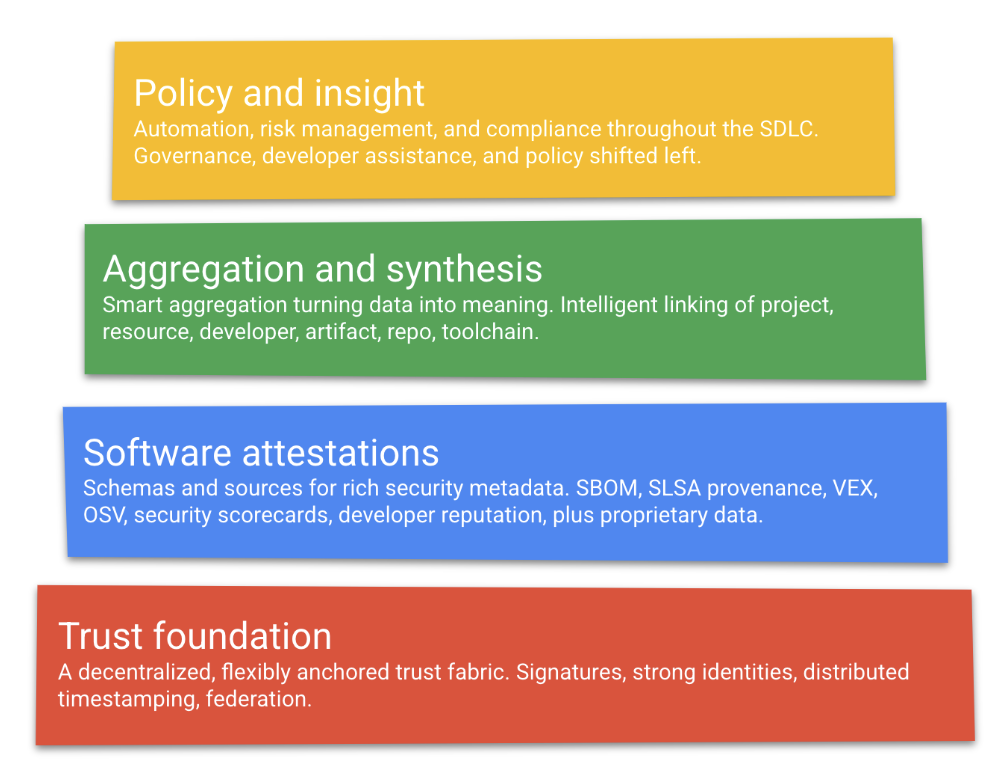
Conceptually, GUAC occupies the “aggregation and synthesis” layer of the software supply chain transparency logical model:
image

A few examples of questions answered by GUAC include:

image

Quickstart

Our documentation is a good place to get started.

We have various demos use cases that you can take a look.

Starting the GUAC services with our docker compose quickstart.

Try in a Dev Container

The repo ships a .devcontainer config that brings up the full GUAC stack (GraphQL, REST, collectsub, ingestor, NATS, and the deps_dev / osv / ClearlyDefined collectors) locally on Docker, backed by the published GUAC release image. Open the repo in VS Code with the Dev Containers extension and select "Reopen in Container" -- the GraphQL playground forwards to port 8080 and the REST API to 8081. Also works with JetBrains Gateway and DevPod.

Docs

All documentation for GUAC lives on docs.guac.sh, backed by the following docs github repository.

Architecture

Here is an overview of the architecture of GUAC:

guac_api

For an in-depth view and explanation of components of the GUAC Beta, please refer to how GUAC works.

Supported input documents

  • CycloneDX
  • Dead Simple Signing Envelope
  • Deps.dev API
  • In-toto ITE6
  • OpenSSF Scorecard
  • OSV
  • SLSA
  • SPDX
  • CSAF/CSAF VEX
  • OpenVEX

Note that GUAC uses software identifiers standards to help link metadata together. However, these identifiers are not always available and heuristics need to be used to link them. Therefore, there may be unhandled edge cases and errors occurring when ingesting data. We appreciate it if you could create a data quality issue if you encounter any errors or bugs with ingestion.

GraphQL backends

GUAC supports multiple backends behind a software abstraction layer. The GraphQL API is always the same and clients should be unaffected by which backend is in use. The backends are categorized into:

  1. Supported/Unsupported: Supported backends are those which the GUAC project is committed to actively maintain. Unsupported backends are not actively maintained but will accept community contributions.

  2. Complete/Incomplete: Complete backends support all mandatory GraphQL APIs. Incomplete backends support a subset of those APIs and may not be feature complete.

  3. Optimized: The backend has gone through a level of optimization to help improve performance.

The two backend that are Supported, Complete, and Optimized are:

  • keyvalue (supported, complete, optimized): a non-persistent in-memory backend that doesn't require any additional infrastructure. Also acts as a conformance backend for API implementations. We recommend starting with this if you're just starting with GUAC!

  • ent (supported, complete optimized) with PostgreSQL: a persistent backend based on Entity Framework for Go that can run on various SQL backends. GUAC only supports ent with PostgreSQL. Other ent backends such as MySQL and SQLite are unsupported.

The other backends are:

  • arangoDB (unsupported, incomplete, optimized): a persistent backend based on ArangoDB

  • neo4j/openCypher (unsupported, incomplete): a persistent backend based on neo4j and openCypher. This backend should work with any database that supported openCypher queries.

  • keyvalue: Redis (experimental, complete): The default keyvalue backend, but using Redis as storage.

  • keyvalue: TiKV (experimental, complete): The default keyvalue backend, but using TiKV as storage.

Additional References

  • GUAC use cases
  • GUAC presentation at OSS NA 2023
  • GUAC 2023 Q1 Maintainer Summit Notes
  • GUAC presentation at KubeCon NA 2022
  • GUAC Intro Slides
  • GUAC Design Doc

Communication

For more information on how to get involved in the community, mailing lists and meetings, please refer to our community page

For security issues or code of conduct concerns, an e-mail should be sent to GUAC-Maintainers@lists.openssf.org.

Governance

Information about governance, including the project charter, can be found in the guacsec/governance repo.

Press Escape to close the search panel.

Donate

Buy me a Coffee

Penetration Testing Services

penetration Testing Services

Web Application Security Quiz

Web Application Security Quiz

Daily Bug Bounty Writeups - Twitter

Daily Bug Bounty Writeups

Download our Latest Android Application

Guide for Penetration Testing

Daily Bug Bounty Writeups - Telegram

Daily Bug Bounty Writeups

Author

Piyush
Senior Product Security Engineer

Ethical Hacker || Penetration Tester || Gamer || Blogger || Product Security Engineer || AI Security

READ ARTICLE

Donate

Buy me a Coffee

Recent Posts

  • Inside Java2Shell (CVE-2026-114938)
    Inside Java2Shell (CVE-2026-114938)
    November 18, 2026/
    0 Comments
  • Why GTA 5 Was a Hacker’s Playground — And The Exact Security Architecture GTA 6 Needs
    Why GTA 5 Was a Hacker’s Playground — And The Exact Security Architecture GTA 6 Needs
    November 18, 2026/
    0 Comments
  • Securing the AI Supply Chain: A Hands-On AI-BOM Playbook for Pickle RCE, Poisoned Datasets, and CI Gates
    Securing the AI Supply Chain: A Hands-On AI-BOM Playbook for Pickle RCE, Poisoned Datasets, and CI Gates
    November 17, 2026/
    0 Comments

Follow Us

SECURITY DISPATCH

Subscribe to SecurityCipher

Get the latest bug bounty writeups, offensive security tooling, and zero-day analyses delivered to your inbox.

Subscription Form

SecurityCipher

Practical security guides, vulnerability deep-dives, and hands-on resources for bug bounty hunters and penetration testers.

Useful Links

  • Security Checklists
  • Cybersecurity Jobs
  • Blogs
  • Docs
  • About
  • Contact

Free Resources

  • Interactive Security Labs
  • Security Tools Directory
  • Pentest Roadmap
  • OWASP LLM Top 10
  • Bug Bounty Writeups
  • Bug Bounty Programs
© 2026 Security Cipher. All rights reserved. Privacy Policy · Terms & Conditions · DMCA ·
PRIVACY & DATA CONTROLS

Privacy & Cookie Preferences

We use essential cookies to maintain secure sessions and analyze anonymized telemetry to optimize our research and interactive labs.

Manage anytime via our Privacy Policy or footer settings.

Security Researchers
OPEN DIRECTORY Verified Network

Are you a security researcher or bug hunter?

Join our open directory of verified pentesters, showcase your achievements, and get recognized!

Submit Researcher Profile →