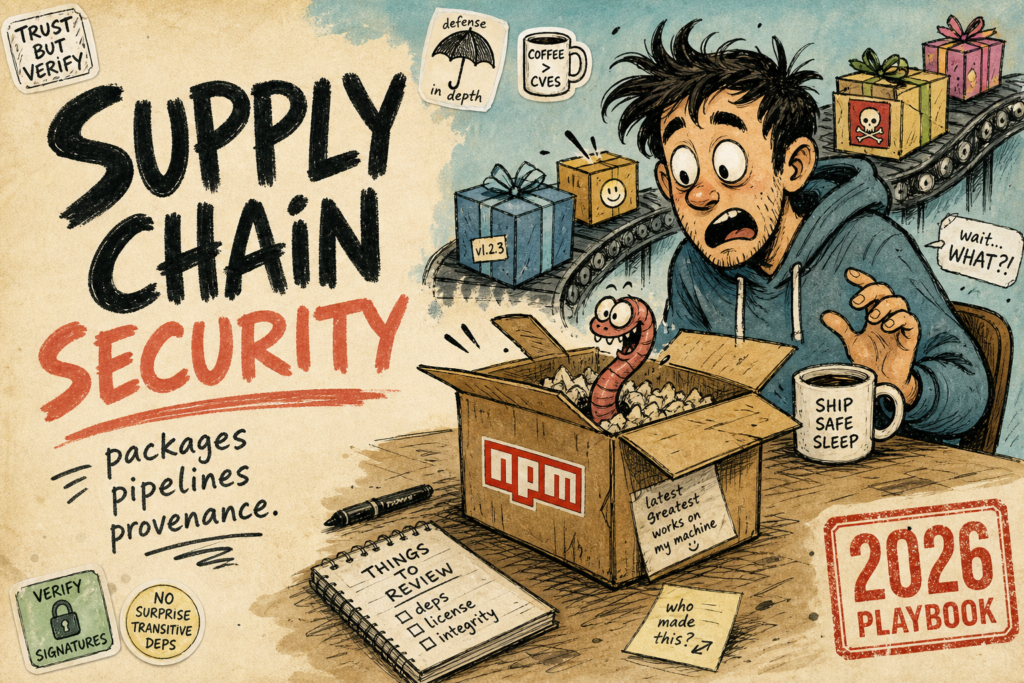
Most teams still treat supply chain security like a compliance checkbox: generate an SBOM once a quarter, turn on Dependabot, call it done. Meanwhile attackers stopped "hoping someone typos a package name" and started shipping self-propagating worms that steal maintainer tokens, republish hundreds of packages, and ride your CI secrets to cloud accounts. August 2026's ChainDrop wave (a Mini Shai-Hulud variant across 400+ npm packages) is the latest reminder: the install hook fires before your tests do.
This is a practical playbook for defenders and testers. You will map the real attack surface (packages, pipelines, provenance), walk the kill chain with recent incidents, test yourself against realistic scenarios, and leave with checks you can run against a repo you own. Pair it with our CI/CD Security Checklist when you want the control-by-control grind.
The short version (TL;DR)
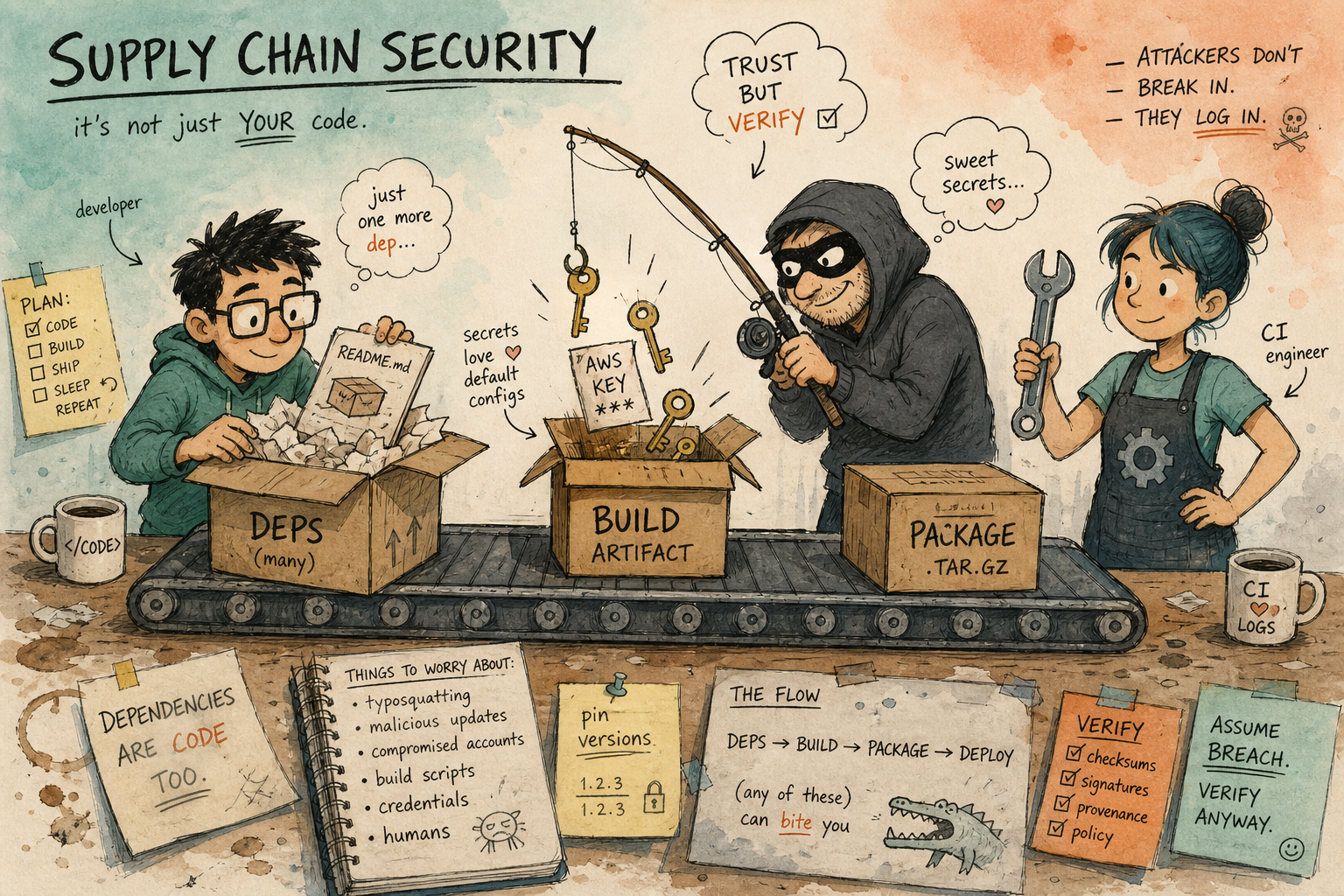
- Software supply chain security is not "scan CVEs in packages." It is integrity of everything between a developer's keyboard and production: registries, lockfiles, CI runners, Actions, publish identities, and promotion gates.
- 2025-2026 attacks went from typosquats to worms (Shai-Hulud, ChainDrop), Action tag poisoning, and pipeline hijacks that still produce valid SLSA provenance.
- Lifecycle scripts (
preinstall/postinstall) are a favorite execution point - on laptops and in CI. - Pin Actions to full commit SHAs, prefer OIDC over long-lived tokens, block install scripts by default, and verify digests on promote - not just "signed by our org."
- Use Syft + Grype for an SBOM and vulnerability gate, OSV-Scanner for lockfiles, Trivy for a wider repo/image sweep, and OpenSSF Scorecard for repository posture.
- Run the 60-second scorecard and scenario drills, then finish with the repo checklist.
Score your supply chain in 60 seconds
Check what you actually do today (not what is on the roadmap). Honest answers beat vanity scores.
Tick the boxes to get a blunt verdict.
What "supply chain" actually means in 2026
If your mental model is still "SolarWinds = bad update from a vendor," update it. Modern software supply chain risk is a stack of trust decisions you make every day without noticing:
| Layer | What you trust | What breaks it |
|---|---|---|
| Source | Maintainer identity, PR review, signed commits | Stolen accounts, social-engineered maintainers (XZ Utils), malicious PRs into release paths |
| Dependencies | npm / PyPI / Maven / crates / Go modules | Typosquats, slopsquats, dependency confusion, wormed republishes |
| Build | CI workflows, runners, caches, reusable Actions | Mutable tags, pull_request_target secrets, cache poisoning, over-privileged tokens |
| Artifacts | Containers, packages, SBOMs, attestations | Rebuild-between-stages, provenance that is true but meaningless, unsigned digests |
| Deploy | Promotion gates, runtime identity | "Latest" tags, skipped approvals, shared deploy keys |
Notice what is missing from that table: a single CVE scanner alert. Vulnerability management still matters. It just does not stop a clean package that becomes malicious on Tuesday afternoon.
Why supply chain attacks got louder (and smarter)
1. Worms beat one-off malware
Shai-Hulud showed the template in 2025: compromise a publisher identity, republish packages with a credential-stealing payload, use stolen tokens to infect the next publisher. ChainDrop (August 2026) followed with a Mini Shai-Hulud variant across hundreds of npm packages - including ones sitting near enterprise ecosystems - executing via preinstall, harvesting npm/GitHub/cloud/Vault secrets, then auto-publishing further infected versions. Propagation is the product now. Your "one bad dependency" can become fifty by Friday.
2. The pipeline is the prize
Attackers love CI because it already has what they want: registry tokens, cloud roles, signing keys, and permission to publish. Mutable GitHub Action tags have been repointed to malicious commits that dump secrets from every consumer workflow. Cache poisoning across fork-to-base trust boundaries has turned "trusted publishers" into malware factories. If you only harden production clusters and leave Actions on @v4, you secured the wrong building.
3. Provenance is necessary - and not sufficient
SLSA Build Level 3 and Sigstore attestations are good. They are not a spell of protection. When malware is injected inside the legitimate release workflow, the attestation correctly says: this package was built by your release job on main. That is true. It is also useless as a malware detector. Provenance tells you the builder. You still have to secure the builder.
4. AI tooling widened the blast radius
Poisoned IDE / agent config files, malicious MCP packages, and "helpful" extensions create a second supply chain beside npm: the developer toolchain itself. If you are already reading our MCP server security playbook, treat agent plugins and coding assistants as in-scope for the same threat model.
The attacker kill chain (map it once, reuse forever)
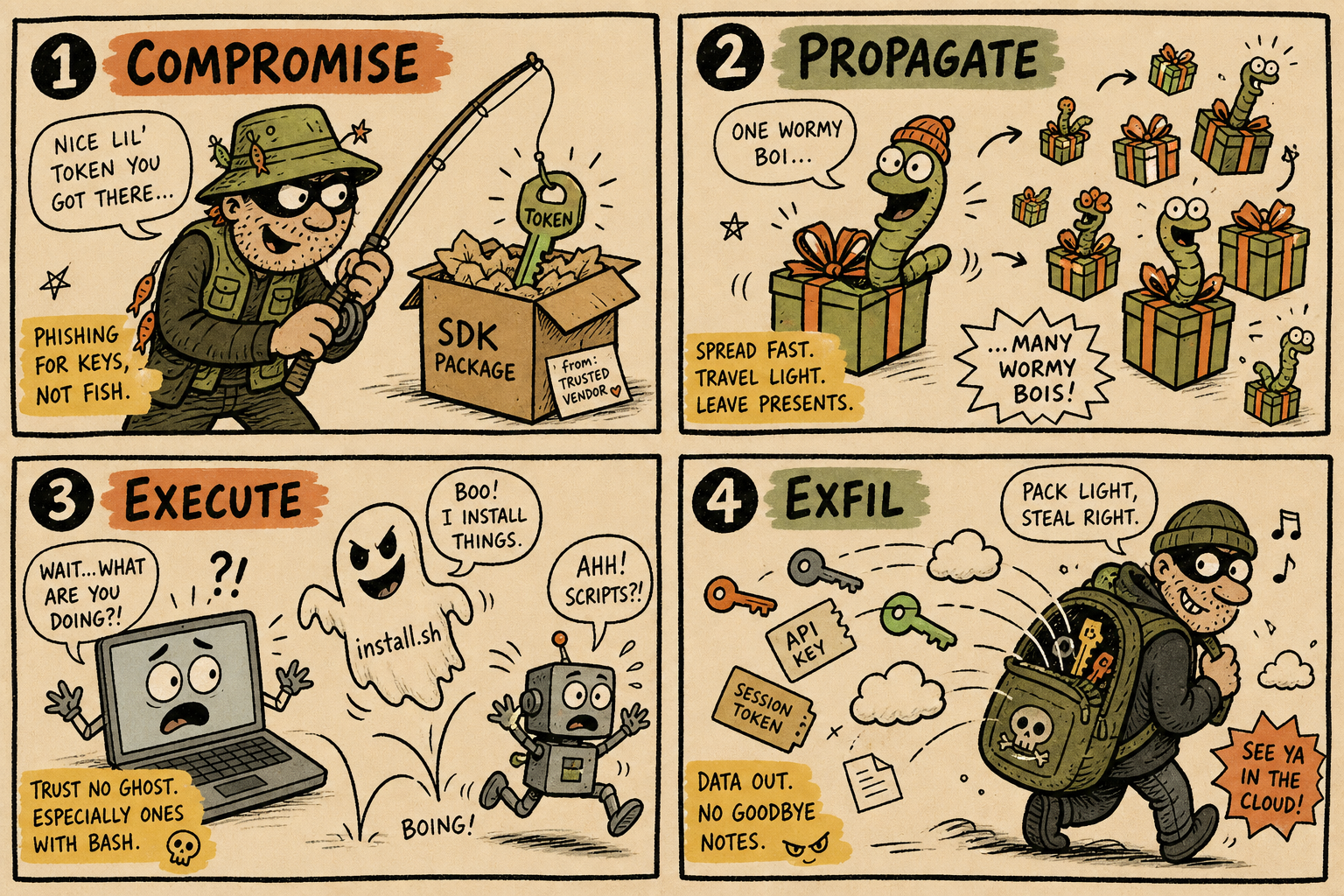
When I review a team's supply chain, I force the conversation onto four stages. If you cannot point to a control at each stage, you do not have a program - you have a hope.
- Compromise - steal a maintainer token, social-engineer a maintainer, typosquat a name, confuse an internal package, or hijack a release workflow.
- Propagate - republish infected versions, move Action tags, poison caches, or open PRs that look helpful.
- Execute - lifecycle hooks on install, CI steps that run untrusted code, postinstall native builds, or agent hooks that run on folder open.
- Exfil / persist - scrape secrets, open backdoors in repos (
.vscode/tasks.json, agent settings), publish more packages, pivot to cloud.
XZ Utils (CVE-2024-3094) is still the textbook for long-game social engineering at the source layer. ChainDrop is the textbook for automated propagation at registry scale. You need defenses for both tempos.
Scenario drills: spot the failure
Open each case, pick what you would check first, then reveal the answer. These mirror real 2025-2026 incidents.
Case A - CI is green. npm just published a new version with "valid" SLSA provenance. Safe to deploy?
What do you verify before promote?
- A) Nothing - SLSA Level 3 means the artifact is clean
- B) Only the Sigstore signature matches the publisher org
- C) Whether the pipeline that signed it could have been poisoned (workflow triggers, cache trust, OIDC publish path)
Reveal answer
C. TanStack-style incidents proved SLSA attestations can be cryptographically correct and still ship malware. Provenance answers "which pipeline built this?" - not "was that pipeline compromised mid-run?" Treat release workflows, cache keys, and pull_request_target like production code.
Case B - A popular Action tag you use just moved. Overnight builds start leaking.
Most likely root cause?
- A) Your app code got a new XSS
- B) The mutable Action tag was repointed to a malicious commit that exfiltrated CI secrets
- C) npm registry downtime caused a fallback to a mirror
Reveal answer
B. Tag-pinning is fake pinning. Incidents like tj-actions / TeamPCP-style Action tag moves show why you pin to a full commit SHA and treat Action updates like dependency upgrades with review.
Case C - Developer runs npm install. Nothing "looks" wrong. Cloud keys vanish.
Where did execution likely happen?
- A) Inside a post-deploy Kubernetes admission controller
- B) In a package lifecycle hook (
preinstall/postinstall) on the laptop or CI runner - C) Only after the binary was signed for production
Reveal answer
B. ChainDrop / Shai-Hulud-class worms love lifecycle hooks. The install finishes, your CI stays green, and the payload already scraped .npmrc, GitHub tokens, and cloud creds. Default to ignore-scripts unless a package earns an exception.
Case D - Internal package name collides with a public registry name. CI suddenly pulls the public one.
Attack name?
- A) Dependency confusion
- B) SSRF
- C) Cache poisoning
Reveal answer
A. Dependency confusion (and cousins: typosquats, slopsquats). Fix with scoped private packages, registry routing that never prefers public over internal, and CI that fails closed when resolution is ambiguous.
Practical testing playbook (repos you own)
Only run these against systems you are authorized to assess. Treat findings (especially leaked tokens in logs) like sensitive data.
Step 1: Inventory what you actually install
# Node
ls -la package-lock.json pnpm-lock.yaml yarn.lock 2>/dev/null
npm ls --all --omit=dev 2>/dev/null | head
# Python
ls -la poetry.lock Pipfile.lock requirements*.txt 2>/dev/null
# Quick SBOM (Syft) if installed
syft dir:. -o cyclonedx-json > /tmp/sbom.json
Hands-on: generate a real SBOM with Syft
Syft inventories packages in source directories, container images, archives, and filesystems. It can print a quick terminal table or write CycloneDX/SPDX JSON for release evidence. The run below used a small Node.js demo with a lockfile and --ignore-scripts; no package lifecycle hooks were executed.
# macOS
brew install syft

# Inspect a source directory
syft dir:. -o table

# Write a CycloneDX JSON SBOM
syft dir:. -o cyclonedx-json=sbom.cdx.json

# Sanity-check the output
jq '{format: .bomFormat, specVersion, components: (.components | length)}' sbom.cdx.json
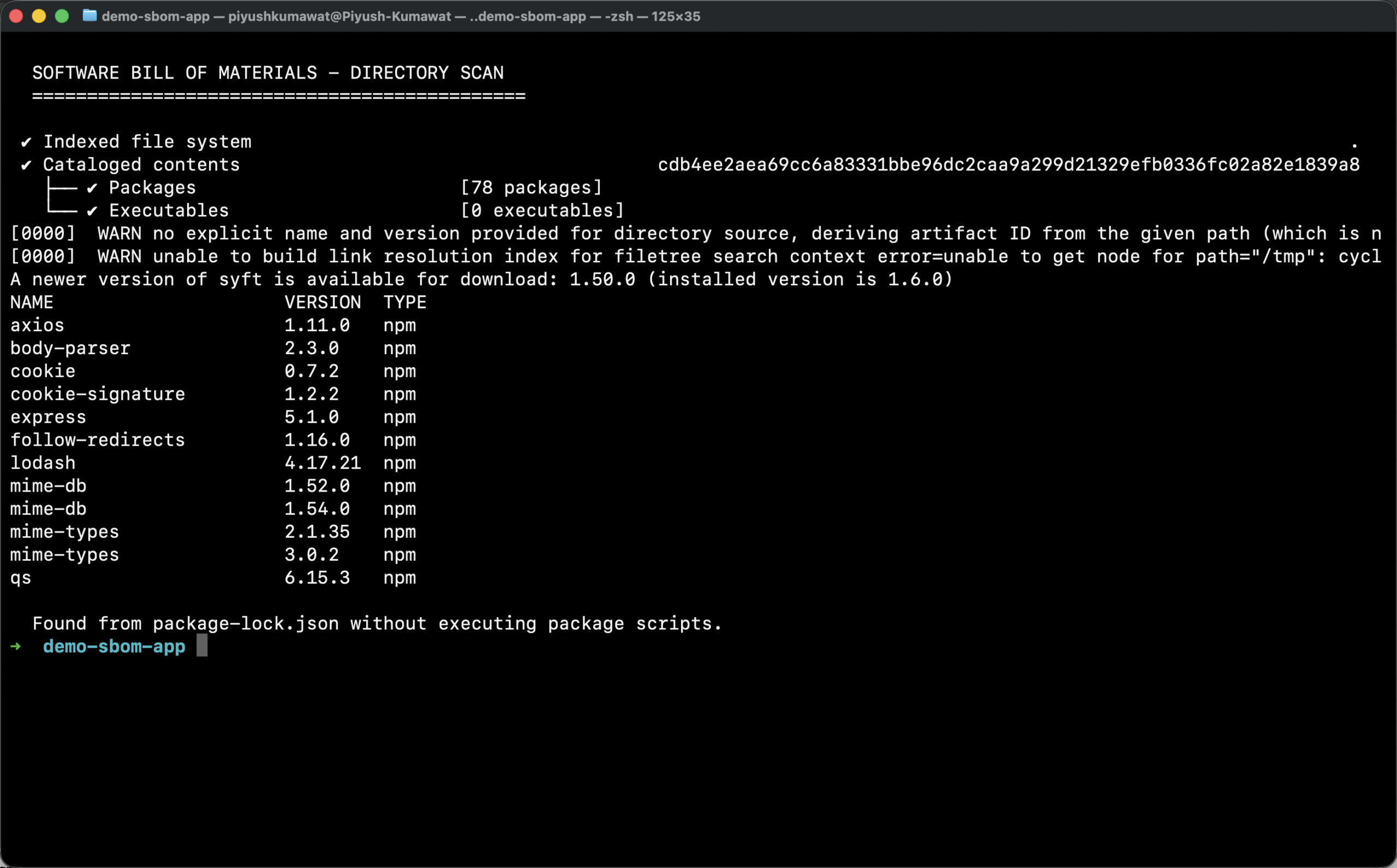
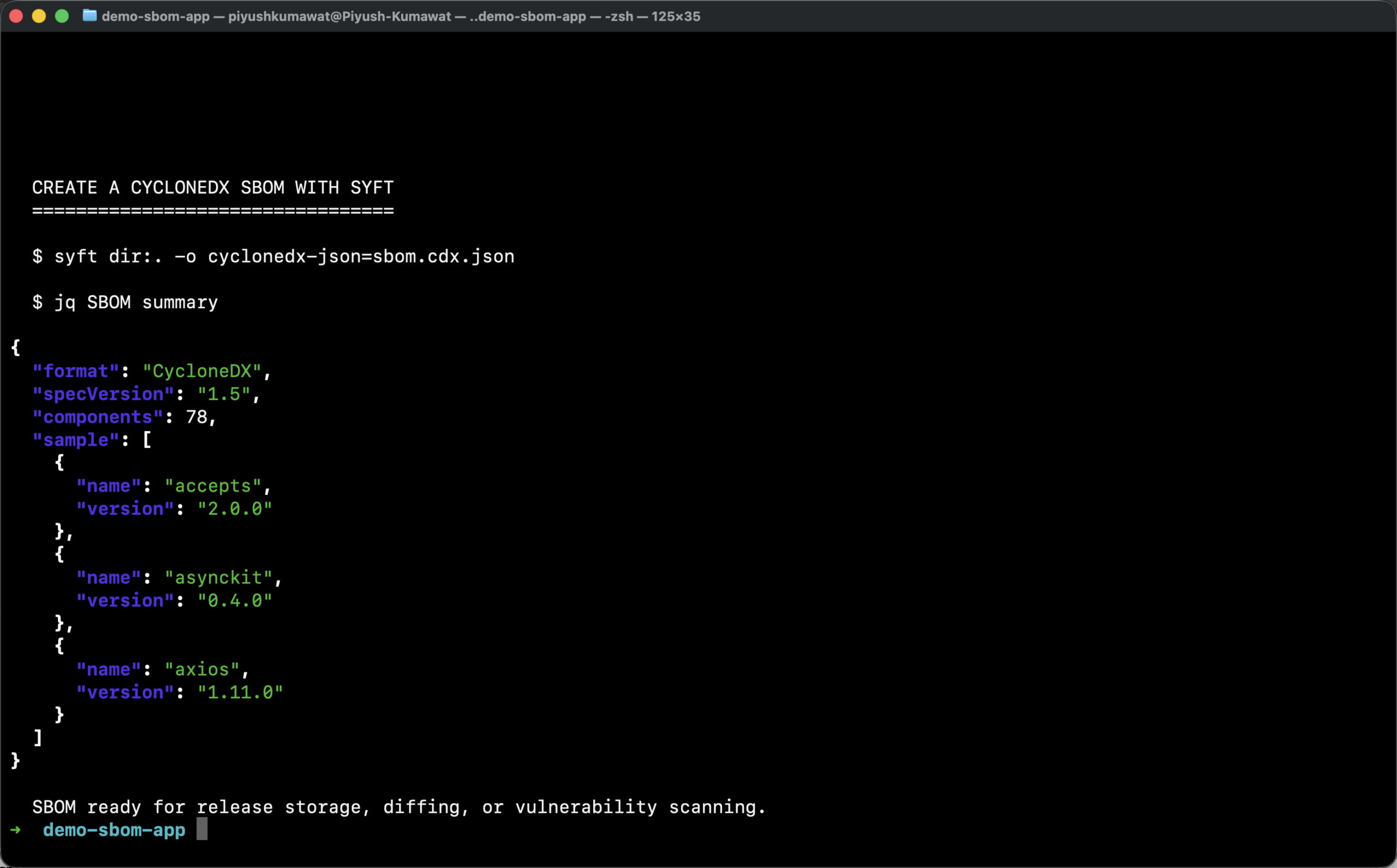
What to do with the file: store sbom.cdx.json beside the exact release digest, upload it as a CI artifact, diff component changes between releases, and feed it into a vulnerability scanner such as Grype or Dependency-Track. An SBOM that lives only on one engineer's laptop is not incident-response evidence.
The practical tool stack (and what each tool misses)
Do not bolt seven scanners into CI on day one. Start with one tool for inventory, one for known vulnerabilities, and one for repository posture. Add signing and an SBOM platform when releases are stable enough to preserve evidence. This is the stack I would reach for:
| Job | Tool | Use it for | What it will not prove |
|---|---|---|---|
| Inventory | Syft | Generate CycloneDX/SPDX SBOMs from directories, images, and archives | Whether a listed package is malicious |
| SBOM vulnerability gate | Grype | Scan Syft output and fail builds on actionable severities | Typosquats or a new compromise with no advisory |
| Lockfile advisory check | OSV-Scanner | Fast ecosystem-aware checks against OSV data | CI workflow poisoning and stolen publisher identities |
| Repo + image sweep | Trivy | Dependencies, container images, secrets, and IaC misconfigurations | That a valid release pipeline is trustworthy |
| Repository posture | OpenSSF Scorecard | Branch protection, dangerous workflows, pinned dependencies, token permissions | Runtime malware behavior inside a package |
| Sign + verify | Cosign | Sign images/blobs and verify identity, digest, and attestations | That the signer or builder was not compromised |
| Continuous SBOM tracking | Dependency-Track | Store SBOMs, monitor components, and alert across many services | Install-script execution or CI secret theft by itself |
A 20-minute local workflow
Run this from a repository you own. The point is not to collect pretty reports. It is to answer four questions: what is here, what is known-vulnerable, what changed, and can the build be trusted?
# 1. Inventory everything Syft can identify
syft dir:. -o cyclonedx-json=sbom.cdx.json

# 2. Scan the SBOM. Exit non-zero when a fixable High/Critical is present
grype sbom:sbom.cdx.json --only-fixed --fail-on high

# 3. Check the lockfile directly against OSV
osv-scanner scan --lockfile=package-lock.json

# 4. Sweep the repo for vulnerable packages, secrets, and IaC mistakes
trivy fs --scanners vuln,secret,misconfig \
  --severity HIGH,CRITICAL --exit-code 1 .

# 5. Review the repository's supply chain posture
scorecard --repo=https://github.com/OWNER/REPO --show-details
What happened in the demo run: Syft inventoried 78 npm components. Grype and OSV-Scanner both flagged the intentionally old Axios and Lodash versions. That is useful correlation: two advisory sources agree on specific packages and fixes. It still does not tell us whether a package was wormed yesterday, so the lifecycle-script and CI checks below remain mandatory.
Turn it into a CI gate
# CI shell step after a frozen dependency install
set -euo pipefail

syft dir:. -o cyclonedx-json=sbom.cdx.json
grype sbom:sbom.cdx.json --only-fixed --fail-on high

# Preserve evidence even when the scan fails
# Upload sbom.cdx.json and the scanner report as CI artifacts.
Do not hide every result behind continue-on-error. A useful policy is: block fixable Critical/High findings in changed production dependencies, warn on the rest, and require an expiring exception with an owner. Store the SBOM even on failed builds so the team can investigate exactly what CI saw.
No lockfile in CI = you do not have reproducible builds. Fix that before arguing about attestations.
Step 2: Hunt lifecycle scripts and weird packages
# Flag packages that run install scripts (Node)
npm query ":attr(scripts, [preinstall], [install], [postinstall])" 2>/dev/null
# Or rip through lock + node_modules package.json files
rg -n '"preinstall"|"postinstall"|"install"' node_modules/*/package.json 2>/dev/null | head -50
# Look for brand-new / rare deps in recent commits
git log --since='90 days ago' -p -- package.json | rg '^\+\s+"[^"]+":' | head
Step 3: Audit CI like production code
# Floating Action tags (bad)
rg -n "uses: .*@v[0-9]" .github/workflows || true
# Prefer full 40-char SHAs
rg -n "uses: .*@[0-9a-f]{40}" .github/workflows || true
# Dangerous triggers / over-broad permissions
rg -n "pull_request_target|permissions:|secrets\." .github/workflows
# Default token posture
gh api repos/OWNER/REPO/actions/permissions/workflow
Anything using pull_request_target with checkout of untrusted code, or Actions pinned only to a moving tag, goes on the finding list immediately. Same for contents: write on every job "just in case."
Step 4: Prove what you ship
- Generate an SBOM at build time and store it with the release (CycloneDX or SPDX).
- Record the image/package digest you promote - never "retag latest and hope."
- Verify attestations and review the workflow that produced them.
- Ask: can a forked PR influence cache contents or secrets for the release job?
Step 5: Rehearse the bad day
Pick a fake package name. Pretend it was wormed. Time how long until you can: list every service that pulled it, revoke publish tokens, rotate cloud credentials that touched CI, rebuild from known-good lockfiles, and communicate. If that drill takes days, ChainDrop would have taken your weekend.
Controls that actually move risk
| Control | Why it matters | Failure mode if skipped |
|---|---|---|
Lockfiles + npm ci / frozen installs | Stops silent version drift | Different malware on different machines |
ignore-scripts by default | Kills the favorite worm execution path | preinstall steals tokens during "just installing deps" |
| Action SHA pins + reviewed upgrades | Stops tag-move secret dumps | Overnight CI becomes an exfil bot |
| Least-privilege CI tokens / OIDC | Shrinks blast radius | One job = org-wide keys |
| Ephemeral runners + egress allowlists | Limits lateral movement and callbacks | Long-lived builders become beachheads |
| SBOM + digest promotion | Makes incident response possible | "We might be affected" forever |
| Private scope + registry routing | Blocks dependency confusion | CI prefers attacker's public package |
| Release workflow hardening | Keeps provenance meaningful | Valid signatures on bad code |
For the deeper control catalog - branch protection, runner isolation, secret handling, artifact promotion - work through the CI/CD Security Checklist. For code-level review habits that catch suspicious dependency changes in PRs, use the Secure Code Review Checklist.
Supply chain review checklist
Tick each control as you verify it. These boxes are for the review session and reset when the page reloads.
FAQ
Is an SBOM enough for supply chain security?
No. An SBOM is an inventory. It helps you answer "are we affected?" after a worm or CVE drops. It does not stop a malicious preinstall from running, and it does not harden your release workflow. Generate SBOMs anyway - then pair them with install-script policy, CI hardening, and digest-based promotion.
If we have SLSA Level 3, are we safe?
Safer than unsigned mystery builds - not safe by default. SLSA tells you which builder produced an artifact. If that builder can be influenced by a poisoned cache, a dangerous workflow trigger, or a stolen OIDC publish path, you can get valid provenance on malicious output. Secure the pipeline that signs.
Do Dependabot / Renovate replace this work?
They help with known vulnerabilities and version drift. They do not detect brand-new wormed releases with no CVE yet, and auto-merge without review can accelerate a bad update. Keep them. Add human review for high-impact packages and never auto-merge CI/Action changes blindly.
Is this only an npm problem?
npm is the loudest ecosystem right now, but the same patterns hit PyPI, Maven, RubyGems, containers, and VS Code / OpenVSX extensions. The controls translate: pin what you run, limit what install/build steps can do, and verify what you promote.
Where should a small team start this week?
Three moves: (1) enforce lockfiles + ignore-scripts, (2) pin GitHub Actions to SHAs on release workflows, (3) cut default CI token permissions to read and use OIDC for cloud publish. Then score yourself with the widget above and knock out the next three gaps.
Bottom line
Supply chain security stopped being a niche compliance topic the day worms learned to republish your dependencies for you. Treat packages, pipelines, and provenance as one system. Assume install hooks are hostile. Assume Action tags move. Assume a green check plus a valid attestation can still mean "attacker got into the builder."
Run the scorecard, work the four cases, then run Syft, Grype, OSV-Scanner, Trivy, and Scorecard against a real repo. Keep the tools that answer a distinct question; remove redundant noise. When you want the full control map, open the CI/CD Security Checklist. If you are thinking like an attacker against a young company stack, the companion read is How I Would Hack Your Startup in 24 Hours.