
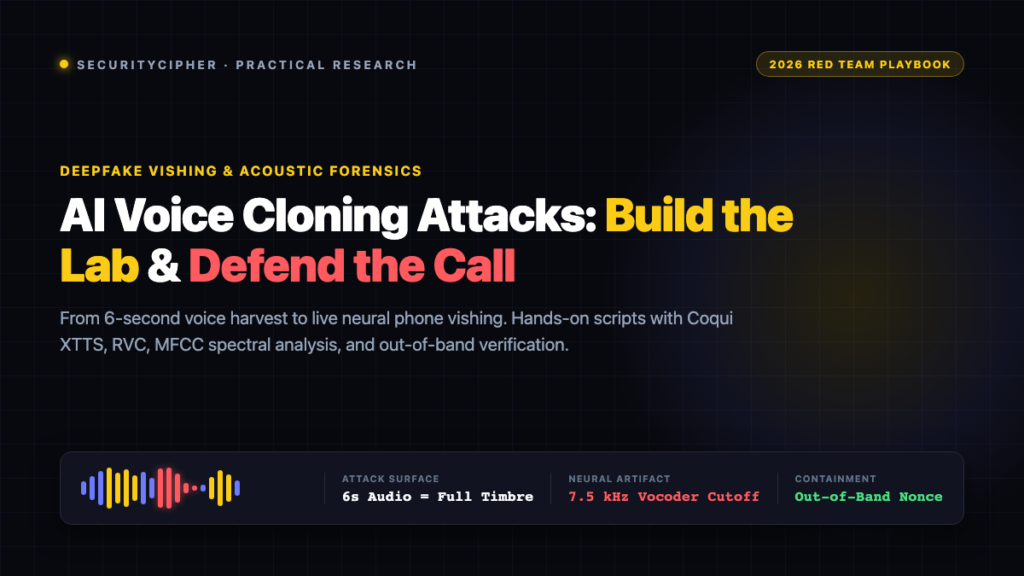
In 2026, an attacker does not need to compromise an Active Directory domain or steal an SSH private key to move money out of your company. They only need six seconds of clean audio from your CEO's latest YouTube keynote, podcast interview, or earnings call. With that snippet, open-source neural weights can clone the executive's vocal tract, timbre, and cadence with near-perfect fidelity. Then comes the phone call to the finance desk at 4:45 PM on a Friday.
This is not a theoretical lab curiosity. An employee at the multinational engineering firm Arup authorized 15 transfers totaling $25 million after a video call where every single executive on screen - including the CFO - was an AI-generated clone. Attackers targeted LastPass with cloned CEO voice memos over WhatsApp, and attempted to hit Wiz with executive voicemails. When voice cloning combines with urgency and unmonitored communication channels, traditional security awareness training completely collapses.
Quick take
- The attack bar is zero cost: Open-source zero-shot models (Coqui XTTS v2) and speech-to-speech converters (RVC) clone realistic voices locally on consumer GPUs without subscription fees or safety guardrails.
- Six seconds is enough: Public keynotes, earnings calls, and LinkedIn videos provide more than enough clean vocal data to condition neural vocoders.
- The real failure is voice trust: Training employees to "listen for robotic voices" fails because state-of-the-art neural speech-to-speech preserves human cadence, breathing, and emotional inflection.
- Acoustic forensics can spot artifacts: Synthetic vocoders leave mathematical signatures, including brick-wall high-frequency cutoffs at 7.5 kHz, absent respiratory micro-events, and harmonic phase incoherence.
- The durable defense is operational: Never rely on audio detection alone. Enforce out-of-band verification callbacks and dynamic challenge-response nonces for any financial or sensitive credential action.
For twenty years, security awareness programs taught people to look for telltale signs in emails: misspelled domains, awkward phrasing, strange sender headers. That playbook does not translate to telephony. When a finance manager picks up the phone and hears their actual boss speaking with their distinct cadence, asking about a real deal currently in progress, skepticism evaporates.
Attackers exploit three specific psychological and technical leverage points:
- Manufactured urgency: Attackers fabricate time-sensitive crises - an acquisition deposit before the wire window closes, an emergency server outage requiring an MFA reset, or a transit delay. Urgency compresses decision cycles and makes employees skip verification steps.
- Channel pivoting: Attackers deliberately move targets off monitored corporate platforms (like Slack or Microsoft Teams) onto direct mobile calls or WhatsApp voice memos, where endpoint monitoring and call recording are absent.
- Context injection: Scammers scrape recent corporate press releases, LinkedIn updates, and travel schedules to drop casually accurate details ("I just landed at Heathrow, need this cleared right now") into the conversation.
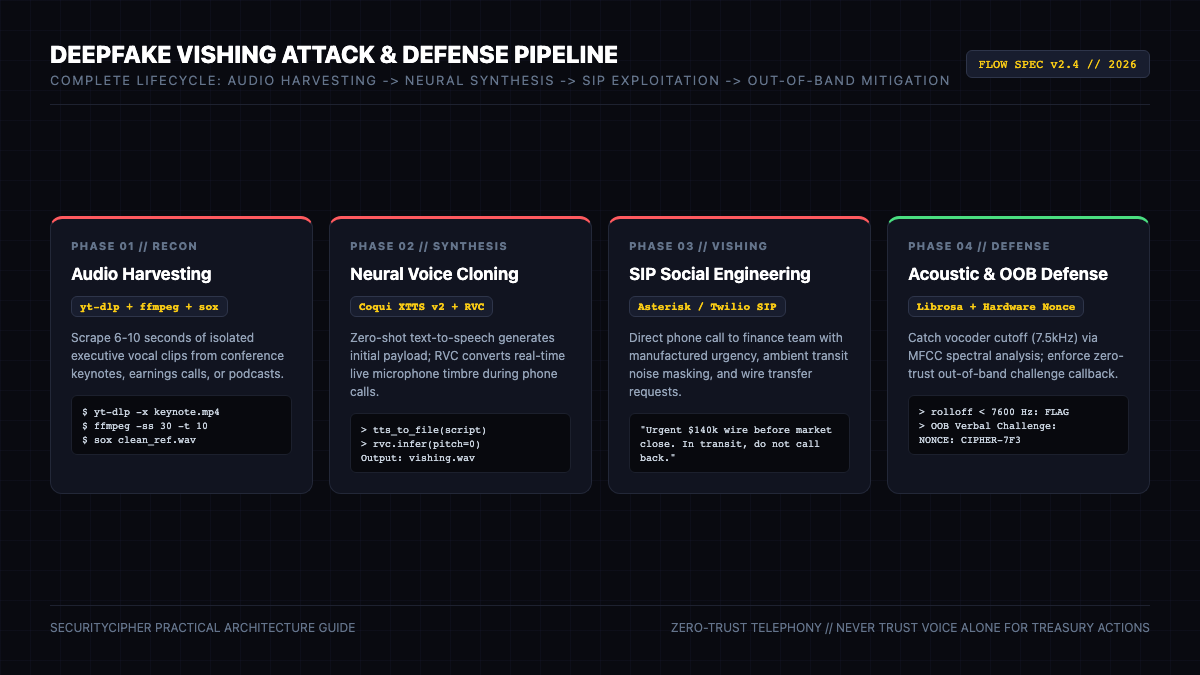
Phase 1: Harvesting and preparing executive audio
In a professional red-team engagement or adversarial scenario, the first step is acquiring clean reference audio. Corporate leaders leave vast acoustic footprints across public media. A 20-minute conference presentation typically contains several minutes of uninterrupted speech without loud background music.
Here is the exact terminal workflow used to extract and isolate a reference clip from a public video using open-source command-line tools:
# Step 1: Download raw audio from public conference or interview
yt-dlp -x --audio-format wav --audio-quality 0 -o "target_raw.wav" "https://www.youtube.com/watch?v=EXAMPLE_ID"

# Step 2: Slice a 10-second isolated vocal segment (mono, 22.05 kHz sample rate)
# In this example, clean speech starts at minute 02:15 (135 seconds)
ffmpeg -i target_raw.wav -ss 135 -t 10 -ar 22050 -ac 1 target_reference.wav

# Step 3: Remove room reverb and background air conditioning noise with sox
sox target_reference.wav target_clean.wav noisered /tmp/noise.prof 0.21 norm -1
For optimal zero-shot cloning, the reference clip needs to be 6 to 12 seconds long, completely dry (no background soundtrack), and spoken in the target's natural conversational register rather than an amplified stage projection.
Phase 2: Building the clone (TTS vs Speech-to-Speech)
Attackers utilize two distinct architectures depending on whether they are sending pre-recorded voice memos or conducting interactive live calls. Understanding the difference is crucial for defenders.
1. Zero-Shot Text-to-Speech (TTS): Models like Coqui XTTS v2 accept written text and condition the output waveform using the acoustic embedding of the reference sample. This works well for voicemails and WhatsApp notes.
# zero_shot_clone.py - Standalone Python TTS generator
import torch
from TTS.api import TTS

device = "cuda" if torch.cuda.is_available() else "cpu"
print(f"[*] Initializing XTTS v2 on {device}...")

# Load multilingual zero-shot voice cloning model
tts = TTS("tts_models/multilingual/multi-dataset/xtts_v2").to(device)

vishing_script = (
    "Hello team, this is Marcus. I am currently in a closed meeting with our legal counsel. "
    "We need to execute an immediate earnest wire deposit of one hundred and forty thousand dollars "
    "to secure the vendor contract before five PM. Please expedite this immediately."
)

tts.tts_to_file(
    text=vishing_script,
    speaker_wav="target_clean.wav",
    file_path="output_vishing_memo.wav",
    language="en",
    temperature=0.68,
)
print("[+] Voice clone generated successfully: output_vishing_memo.wav")
2. Real-Time Speech-to-Speech (STS): When an attacker needs to answer unexpected questions live on a phone call, TTS fails due to unnatural generation pauses. Instead, they run Retrieval-based Voice Conversion (RVC). The attacker speaks into a microphone; RVC extracts the attacker's pitch and vocal cadence, then maps the acoustic timbre onto the target's voice model in real-time with latency under 180 milliseconds.
| Metric | Zero-Shot TTS (Coqui XTTS) | Neural Speech-to-Speech (RVC) |
|---|---|---|
| Input Requirement | Written text + 6s audio clip | Live microphone + 5m training data |
| Latency | 1.5s - 4.0s (batch generation) | 120ms - 250ms (real-time stream) |
| Emotional Cadence | Synthetic / somewhat robotic | Natural human pacing and breath |
| Primary Target | Voicemails, audio memos | Interactive live phone calls |
| Detection Footprint | Brick-wall vocoder cutoffs | Harmonic phase incoherence |
Hands-on: Test deepfake detection in our interactive lab
To see these acoustic artifacts and defenses in action without spinning up GPU hardware, we built a dedicated, browser-based simulation on SecurityCipher. You can practice inspecting incoming audio streams, analyzing vocoder cutoffs, isolating masking noise, and testing out-of-band verification protocols live:
Open AI Voice Cloning & Deepfake Vishing Lab →
Phase 3: Detecting synthetic speech with Python
Human vocal cords are wet, organic physical tissues governed by fluid dynamics. Every human vocalization includes micro-tremors in fundamental frequency (jitter), micro-fluctuations in amplitude (shimmer), and natural inhalation pauses. Neural vocoders generate audio mathematically, leaving distinctive forensic artifacts.
Below is a complete Python forensic script using librosa and numpy that extracts Mel-Frequency Cepstral Coefficients (MFCCs), spectral rolloff, and spectral centroids to spot synthetic audio:
# forensic_audio_detector.py - Detect synthetic voice artifacts
import numpy as np
import librosa

def analyze_audio_forensics(audio_path: str) -> dict:
    # Load audio at standard telephonic rate
    y, sr = librosa.load(audio_path, sr=22050)

    # 1. Spectral Rolloff (Frequency below which 95% of energy lives)
    # Neural vocoders (HiFi-GAN, XTTS) often drop sharply near 7.5 kHz
    rolloff = librosa.feature.spectral_rolloff(y=y, sr=sr, roll_percent=0.95)
    mean_rolloff = float(np.mean(rolloff))

    # 2. Mel-Frequency Cepstral Coefficients (MFCCs)
    mfccs = librosa.feature.mfcc(y=y, sr=sr, n_mfcc=20)
    mfcc_variance = float(np.var(mfccs))

    # 3. Spectral Centroid (Center of mass of spectrum)
    centroid = librosa.feature.spectral_centroid(y=y, sr=sr)
    mean_centroid = float(np.mean(centroid))

    # 4. Zero-Crossing Rate (Measure of voice noisiness vs smoothness)
    zcr = librosa.feature.zero_crossing_rate(y)
    mean_zcr = float(np.mean(zcr))

    # Forensic heuristic scoring
    is_synthetic = False
    reasons = []

    # Vocoder cutoff signature:
    if mean_rolloff < 7600:
        is_synthetic = True
        reasons.append(f"Sharp high-frequency cutoff detected ({mean_rolloff:.1f} Hz < 7600 Hz)")

    # Unnatural spectral smoothness (low MFCC variance):
    if mfcc_variance < 140.0:
        is_synthetic = True
        reasons.append(f"Unnaturally low acoustic variance ({mfcc_variance:.2f} < 140.0)")

    return {
        "file": audio_path,
        "rolloff_hz": round(mean_rolloff, 1),
        "mfcc_variance": round(mfcc_variance, 2),
        "spectral_centroid": round(mean_centroid, 1),
        "is_synthetic": is_synthetic,
        "anomalies": reasons if reasons else ["Acoustics within normal human boundaries"]
    }

# Example run:
if __name__ == "__main__":
    report = analyze_audio_forensics("suspicious_call.wav")
    print("Forensic Analysis Report:")
    for k, v in report.items():
        print(f"  {k}: {v}")
Phase 4: Training an Isolation Forest anomaly detector
Single threshold checks can produce false positives on noisy cellular connections. A more resilient defensive technique involves enrolling authentic executive voice samples and training an unsupervised Isolation Forest classifier. Any incoming transmission whose feature vector deviates from the enrolled baseline triggers an anomaly flag.
# batch_voice_audit.py - Unsupervised anomaly scanner for call recordings
import glob
import numpy as np
import librosa
from sklearn.ensemble import IsolationForest

def extract_feature_vector(file_path: str) -> np.ndarray:
    y, sr = librosa.load(file_path, sr=22050)
    mfcc = librosa.feature.mfcc(y=y, sr=sr, n_mfcc=13)
    contrast = librosa.feature.spectral_contrast(y=y, sr=sr)
    return np.hstack([
        np.mean(mfcc, axis=1),
        np.std(mfcc, axis=1),
        np.mean(contrast, axis=1)
    ])

def train_executive_profile(authentic_samples_dir: str) -> IsolationForest:
    train_vectors = []
    for path in glob.glob(f"{authentic_samples_dir}/*.wav"):
        train_vectors.append(extract_feature_vector(path))

    detector = IsolationForest(contamination=0.05, random_state=42, n_estimators=150)
    detector.fit(train_vectors)
    return detector

def verify_inbound_call(detector: IsolationForest, test_audio: str) -> dict:
    vec = extract_feature_vector(test_audio).reshape(1, -1)
    anomaly_score = detector.decision_function(vec)[0]
    prediction = detector.predict(vec)[0] # -1 for anomaly, 1 for normal

    return {
        "call_file": test_audio,
        "score": round(float(anomaly_score), 4),
        "status": "FLAGGED_DEEPFAKE" if prediction == -1 else "AUTHENTIC_CALL"
    }
Defensive countermeasures that actually work
Here is the hard truth that every security team must accept: technical audio detection is a cat-and-mouse game. As vocoders improve and diffusion-based audio models advance, spectral artifacts shrink. The only durable defense is operational controls that remove voice as an authentication factor.
1. Out-of-Band (OOB) Callback Policy
Establish an ironclad corporate policy: No wire transfer, password reset, or sensitive vendor modification can be authorized solely over an inbound voice call. When an executive calls requesting an urgent transaction:
- Hang up immediately.
- Initiate a callback using a pre-enrolled internal directory number or corporate hardware line - never the phone number from which the call originated.
- Require secondary confirmation via a corporate push notification on an authenticated mobile authenticator app.
2. Verbal Challenge-Response Nonces
For high-risk environments, executive teams and treasury controllers should maintain dynamic verbal passcodes. A simple implementation involves generating an authentication nonce inside the corporate password manager or authenticator app (e.g. CIPHER-984). An attacker running an automated voice clone or an interactive RVC bot will not have access to the dynamic nonce, causing the social engineering pretext to fail immediately.
3. SIEM Telephony Correlation Rule
Correlate PBX telephony logs with treasury actions in your SIEM. The following Splunk search query flags wire transfer requests that were preceded by brief external inbound calls, highlighting potential vishing pretexts:
index=telephony sourcetype=pbx_cdr direction=inbound call_duration<300
| join caller_number [search index=finance action="wire_transfer_initiated" amount>25000]
| eval risk_level=if(call_duration<120 AND amount>100000, "CRITICAL", "HIGH")
| table _time, caller_number, called_extension, call_duration, amount, recipient_bank, risk_level
FAQ
Frequently asked questions
How much reference audio is required to clone a voice?
Modern zero-shot neural models (such as Coqui XTTS v2 and OpenVoice) require as little as 6 to 10 seconds of clean, monophonic speech to replicate vocal timbre and fundamental frequency. For real-time speech-to-speech conversion (RVC), 5 to 10 minutes of audio produces near-flawless conversational mimicry.
Can automated phone filters reliably block deepfake calls?
Acoustic filters can catch known vocoder anomalies (such as high-frequency roll-off cutoffs and unnatural phase coherence), but they are not silver bullets. Attackers frequently introduce artificial background noise (airports, street traffic) to mask vocoder artifacts. Operational out-of-band verification remains mandatory.
What is the difference between TTS and STS voice cloning?
Text-to-Speech (TTS) synthesizes audio directly from written text; it is fast but often sounds slightly robotic with fixed cadence. Speech-to-Speech (STS) takes an attacker's live spoken voice and transforms its timbre to match the victim's voice in real-time, preserving natural human breathing, pauses, and emotional inflection.
Why do traditional security awareness simulations fail against deepfakes?
Most security training assumes social engineering occurs through email or SMS with detectable grammatical errors. Deepfake vishing weaponizes trusted executive voices and conversational authority in real time. Training employees to "listen for anomalies" fails because human ears cannot detect microscopic mathematical vocoder artifacts under telephonic compression.
How do attackers route cloned audio into live telephone calls?
Attackers configure virtual audio cables (such as VB-CABLE or PulseAudio sinks) that route the real-time output of voice conversion software directly into SIP softphones, WebRTC clients, or VoIP trunks (e.g., Asterisk, Twilio), transmitting the synthesized stream directly to the target's telephone.
What should an employee do if they suspect a vishing attempt?
Immediately terminate the call without confirming any information. Do not call back using the caller ID number. Contact the alleged caller via a verified corporate communication channel (internal chat, direct desk phone) and report the incident to the Security Operations Center (SOC) with the time and phone number.
Bottom line
AI voice cloning has permanently eliminated voice as a trustworthy proof of identity. The tools required to execute high-impact vishing attacks are free, open-source, and capable of running on consumer hardware. Trying to solve this problem by training employees to have better ears is a losing battle. The only winning strategy is architectural: implement acoustic inspection in your telephony stack to catch noisy attempts, and enforce strict, non-negotiable out-of-band verification protocols for any action involving money, data, or credentials.