

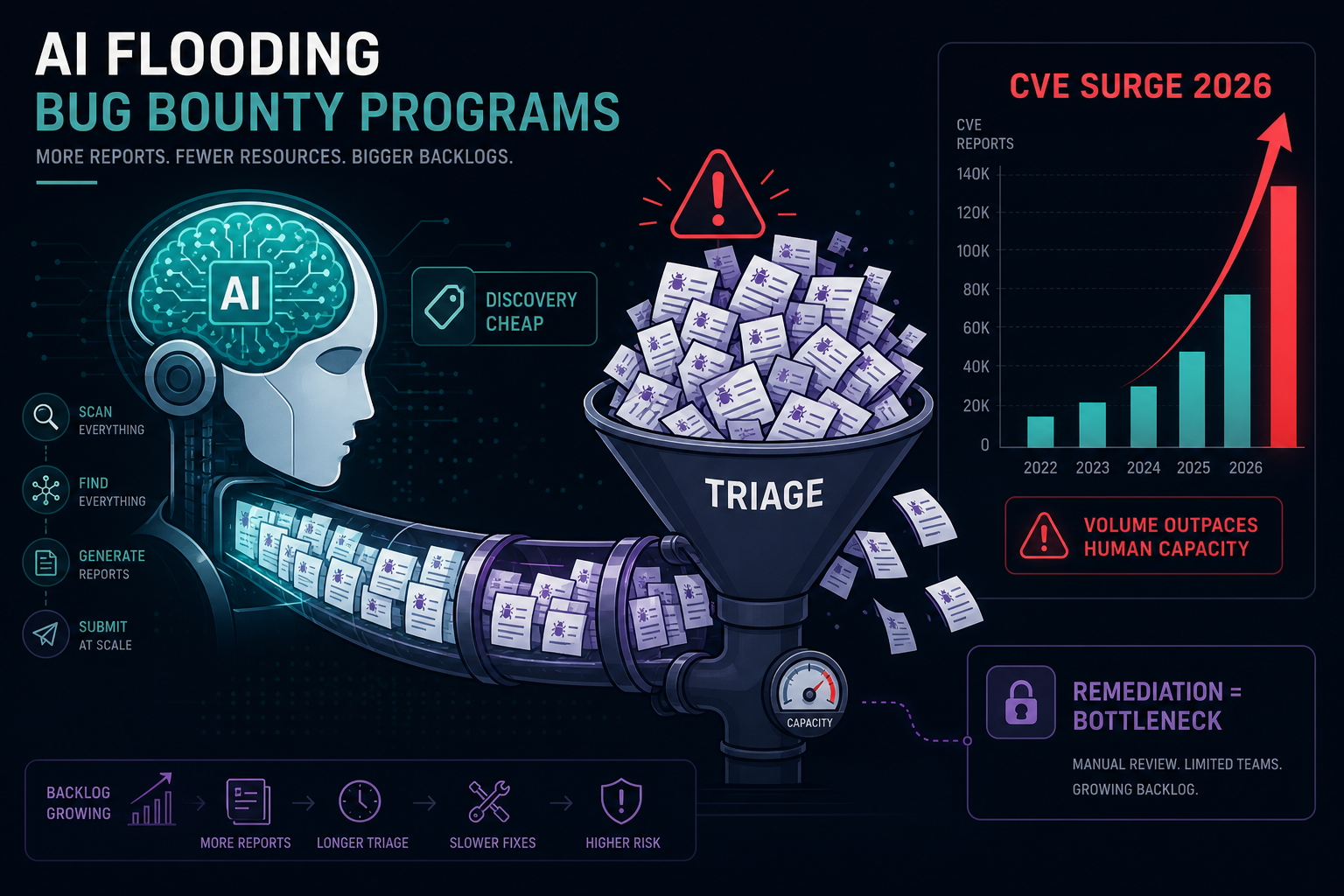
Ask any bug bounty hunter how 2026 is going and you will get one of two answers. Either "I have never found more bugs in my life," or "the programs are dying." Both are true at the same time, and that contradiction is the whole story. AI did not kill bug bounty. It broke the economics of it, flooded the pipes, and forced everyone to admit a truth the industry had been dancing around for years: finding bugs was never the hard part. Fixing them, fast, is.
Let me walk through what actually happened, with the numbers and the sources, and then the part that matters to you - whether you should still bother hunting, and how the smart hunters are adapting instead of quitting.
The short version (TL;DR)
- AI-assisted discovery exploded in 2026. High and critical CVE reports hit roughly 1,500 in June alone across 21 orgs - about 3.5x the previous monthly record, lining up with the release of Anthropic's Claude Mythos.
- Programs drowned in low-value, duplicate, and hallucinated "AI slop." curl, Google, HackerOne, Node.js, and Nextcloud all shut down, paused, or restricted their programs.
- Then something shifted: the slop tapered and was replaced by real AI-supported findings at valid rates back to pre-AI levels and climbing.
- The bottleneck moved. Discovery is cheap now; triage and remediation are the constraint. As HackerOne's CEO put it, the edge is closing speed - the gap between found and fixed.
- AI is not replacing hunters. It is raising the floor - low-hanging fruit gets automated away, and human value moves to impact, business logic, chaining, and clean reporting.
- If you hunt: stop competing on volume. Compete on the bugs AI cannot find and the reports triagers actually want.
What actually happened in 2026
In April 2026, Anthropic announced that Claude Mythos could find software vulnerabilities on its own. Not "help a human find" - autonomously discover, and in many cases write a working exploit. Its Glasswing partner program reportedly uncovered more than 10,000 high or critical vulnerabilities. OpenAI's Daybreak program added to the wave. Suddenly the thing that took a skilled researcher days of focused work could be run at scale, overnight, by a model.
The data backs the vibe. Epoch AI charted the spike: about 1,500 high-severity and critical CVEs reported by 21 organizations in June 2026, more than 3.5 times the previous monthly record (The Decoder). FIRST, the group that forecasts CVE volume, revised its 2026 projection to roughly 66,000 CVEs, about 46 percent above the original forecast (Winbuzzer). Whatever you think of AI, it is objectively finding, or helping find, a staggering amount of real broken code.
The slop flood - and the programs that broke
Here is the ugly middle chapter. Before the quality AI findings arrived, the noise came first. Maintainers got buried in confident, well-formatted, completely wrong vulnerability reports - the now-infamous "AI slop." A hunter would point a model at a program, get ten "findings" overnight, and fire them all off. Half duplicates, the rest often hallucinated, every one of them eating a human triager's time.
The fallout was brutal and fast (as HackerOne CEO Kara Sprague summarized):
- curl ended its bug bounty program in January after drowning in hallucinated reports. Daniel Stenberg was blunt about it.
- Google stopped accepting AI-generated reports in March.
- HackerOne paused the Internet Bug Bounty the same month.
- Node.js suspended rewards the week after.
- Nextcloud shut its program down in April.
The researcher Cassim Khouani (Aituglo), who sits in the top ranks on YesWeHack, summed up the hunter side perfectly in his "State of Bug Bounty in 2026" (quoted in SecurityWeek): Claude found ten bugs overnight, sounds great, except half were duplicates and the rest took weeks to get triaged because the queue had become unmanageable. Productivity up, payout down, everyone frustrated.
The turn: from slop to signal
Then the interesting thing happened. The programs that shut down for noise started reporting that the noise had stopped - and what replaced it was real. curl said the AI slop dried up and genuine, AI-supported quality reports took its place, at valid rates back to pre-AI levels and rising. The Linux kernel team watched verified bug reports climb from about 2 to 10 per week, hallucinated at first, then increasingly all real (both noted in the Cloud Security Alliance's "Mythos-ready" report).
So the doomsday framing - "AI generates infinite garbage forever" - turned out to be a transition phase, not the end state. The tooling and the operators both got better. The models learned to validate before reporting, and the humans learned to filter before submitting. What is left is a genuinely higher output of real vulnerabilities. Which sounds like good news until you look at who has to deal with all of them.
The real crisis is not discovery. It is remediation.
This is the part everyone missed while arguing about slop. If AI can find 10,000 real bugs, someone still has to triage all 10,000, reproduce them, prioritize them, write the fix, test the fix, and ship it - across a CVE pipeline and patch cycle that were already years behind. The finding got automated. The fixing did not.
HackerOne's CEO Kara Sprague framed it sharply: discovery is not the edge anymore, closing speed is - whether the gap between "found" and "fixed" is short enough to avoid getting owned. And here is the asymmetry that should worry every defender: attackers run the exact same AI tooling, but they have none of the overhead. They do not file reports. They do not coordinate with maintainers. They do not wait in a triage queue. They find what is valid and they work it. The defender's coordination tax is the attacker's head start.
Put another way: a vulnerability sitting in a program's backlog is not private. Anyone running the same scan can find it too. When time-to-exploit collapses to hours and your time-to-patch is measured in quarters, the backlog itself becomes the vulnerability. We are seeing exactly that play out in the real world - see our breakdown of the CVEs exploited within days of disclosure in June 2026.
So should you still hunt? Yes - but differently.
AI raises the floor. The boring, high-volume, pattern-matchable bugs - the reflected XSS on a forgotten parameter, the obvious misconfiguration - are getting automated into the ground, and the payouts for them are collapsing under duplicate pressure. If your entire game was volume on easy bugs, that game is over. But the ceiling did not move. Here is where human hunters still win, and win bigger than before:
- Business logic. An AI does not know that transferring a negative amount, or applying a coupon three times, or skipping a payment step, breaks your specific app. Logic flaws need context the model was never given. This is the single safest place to invest.
- Chaining. A low open redirect plus a token leak plus a permissive OAuth flow equals account takeover. Models find atoms; humans still build molecules.
- Impact and proof. Programs are rebalancing incentives toward remediation and real risk. A clean, reproducible, high-impact report with a clear business consequence is worth more than ever - because it is the thing triagers are desperate for in a sea of noise.
- Use AI as leverage, not autopilot. The productive hunters use models for recon, code reading, and drafting, then verify everything by hand and submit only what is real. Being the person who does not add to the slop pile is now a competitive advantage.
If you want the tooling side of this, we broke down the current AI-assisted stack - PentestGPT, Nuclei AI, autonomous agents, and how to avoid drowning in false positives - in our AI pentest tools roundup. The short version: the tools are leverage, judgment is still yours.
A practical adaptation checklist for hunters
- Pick targets where business logic is rich (payments, multi-tenant SaaS, workflows) - the stuff AI cannot reason about blindly.
- Use AI for the grind: recon, JS analysis, reading source, and drafting - then reproduce every finding by hand before you submit.
- Never mass-submit. One clean, high-impact report beats ten AI maybes and protects your reputation on the program.
- Learn to chain low-severity issues into demonstrable impact - that is where the payouts survived.
- Write for the triager: clear repro steps, real business impact, minimal noise. In a flooded queue, readability is leverage.
- Track which programs are rebalancing toward remediation and quality and lean into those.
If you run a program or defend software
- Rebalance incentives toward remediation. Paying for discovery in an era of infinite discovery is paying for a commodity. Reward reproducible, high-impact findings and invest in closing speed.
- Treat patch velocity as a business metric, not a backlog chore. Continuous triage in hours, not periodic patching in quarters.
- Assume your backlog is public. Anything an AI could find in your dependencies, an attacker's AI already found. Prioritize the internet-facing and the actively-exploited first.
- Do not just shut the program. Closing for noise moves genuine discovery back to people who will not warn you. Filter the noise, keep the channel open.
FAQ
Is bug bounty dead in 2026?
No, but the easy-money version of it is fading. High-volume, low-severity hunting is being automated and duplicated into the ground. Hunting that focuses on business logic, vulnerability chaining, and high-impact, well-documented findings is arguably more valuable now, because it is exactly what programs cannot get from an AI.
What is Claude Mythos and why did it change things?
Claude Mythos is Anthropic's model line, announced in April 2026, capable of autonomously finding software vulnerabilities and often generating working exploits. Its release lines up with the sharp 2026 spike in high and critical CVE disclosures. It made discovery cheap and fast at scale, which is what shifted the industry bottleneck from finding bugs to triaging and fixing them.
What is "AI slop" in bug bounty?
It is the flood of confident, well-formatted, but wrong or duplicate vulnerability reports generated by people pointing AI at programs and submitting the output without verifying it. It overwhelmed triage teams in early 2026 and pushed several major programs to pause or shut down before quality AI-assisted reporting caught up.
I am new. Is it still worth learning bug hunting?
Yes - but learn the parts AI is bad at from day one. Understand how applications actually work so you can spot logic flaws, learn to chain issues into real impact, and practice writing reports a busy triager will love. Use AI to learn faster and to handle the grunt work, not to think for you. The fundamentals matter more now, not less.
Sources and further reading
- SecurityWeek - Will AI Kill the Bug Bounty Industry?
- The Decoder - Security vulnerability reports have exploded since AI models started hunting for bugs
- Winbuzzer - AI bug hunting leads to a dramatic spike of CVE disclosures
- Cloud Security Alliance - Building a "Mythos-ready" security program (PDF)
- Kara Sprague (HackerOne) - On bug bounty programs overwhelmed by AI reports
Bottom line
AI did not kill bug bounty. It killed the illusion that discovery was the valuable part. We are drowning in real vulnerabilities now, and the winners - on both sides - are the ones who can move from found to fixed the fastest. For hunters, that means trading volume for impact and becoming the signal in everyone else's noise. For defenders, it means treating remediation speed as survival. The bugs were always going to be there. The clock is the new battlefield.