
Half the bug bounty writeups on my feed this week were not about a new vulnerability class - they were about a tool. AI tool, specifically. T3MP3ST turning coding agents into 0-day hunters, KaliGPT on the command line, Mephisto poking at WordPress, Caido replacing Burp for a lot of people. So it feels like the right moment to cut through the hype and lay out what the AI pentest toolkit actually looks like in 2026, what each tool is genuinely good at, and where it will waste your time.
This is an opinionated roundup, not a press release. Some of these tools are excellent. Some are demos with a good README. I will tell you which is which, and more importantly, how to slot them into a real workflow without drowning in AI-generated false positives.

The short version (TL;DR)
- There are two families: AI copilots (you drive, AI advises) and autonomous agents (AI drives, you supervise). Copilots are reliable today; full autonomy is still hit or miss.
- PentestGPT is still the best free starting point - a reasoning layer that tells you what to try next based on your findings.
- T3MP3ST is the trending one: a multi-agent "meta-harness" that hijacks your existing AI coding agent (Claude Code, Codex) as the brain, no extra API keys. Impressive, but only recon and a single-agent exploit loop are actually stable.
- Nuclei with AI templates is the highest-ROI addition for bug bounty - turn a CVE or a response into a working template in seconds.
- Caido is the Rust-based Burp alternative worth trying; BurpGPT adds GPT analysis inside Burp itself.
- Everything here produces false positives. Verify by hand before you report. AI slop in bug bounty inboxes is a real, and now widely hated, problem.
- All of this is only legal against targets you have explicit permission to test. Egress scope containment is a feature for a reason.
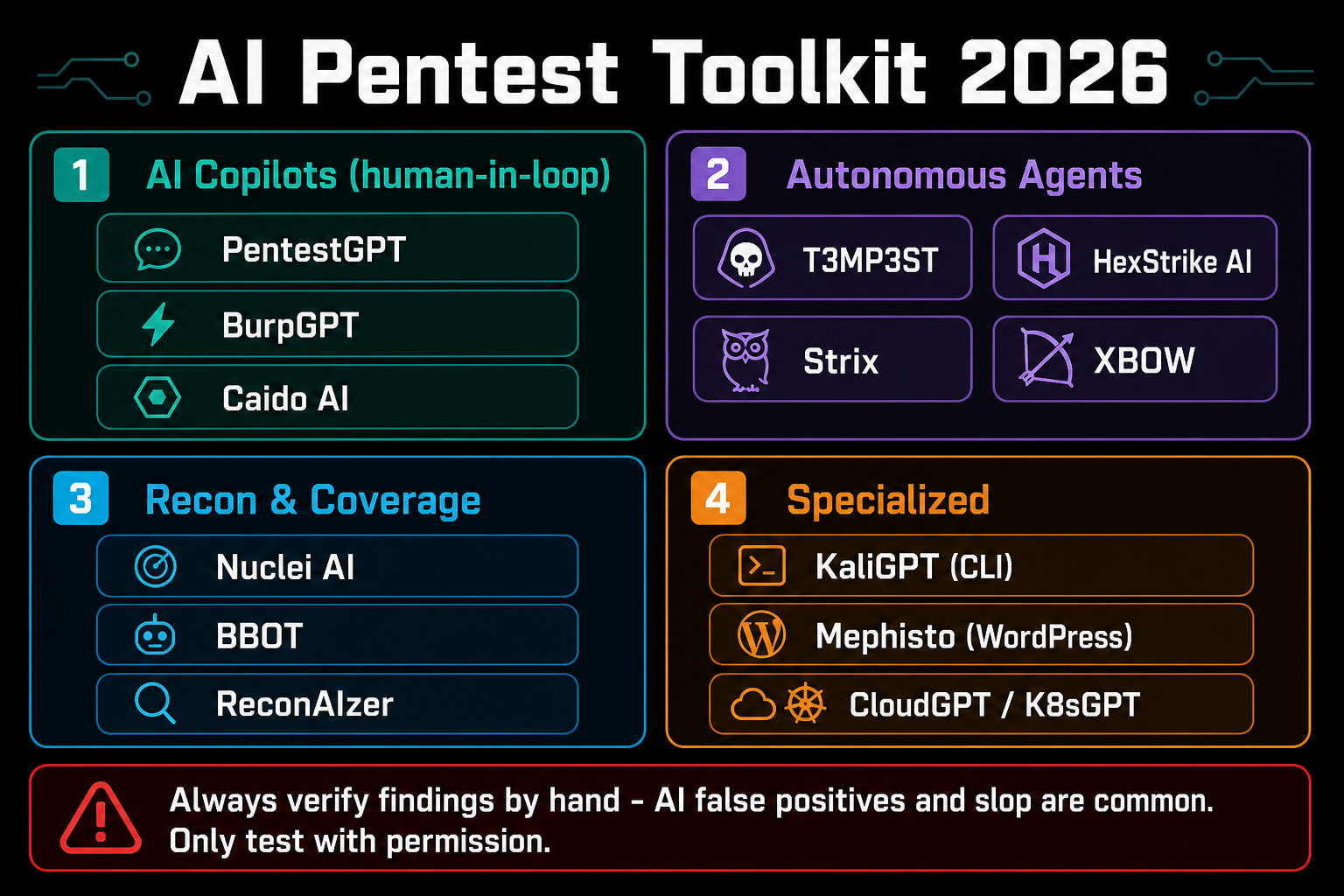
First, understand the two families
Almost every "AI hacking tool" falls into one of two buckets, and confusing them is why people get disappointed.
- AI copilots (human-in-the-loop). You run the engagement. The AI reads your nmap output, your Burp history, your recon logs, and suggests the next move or drafts a payload. It reduces cognitive load, it does not replace judgment. PentestGPT, BurpGPT, ReconAIzer, Caido's AI features live here. This is where the reliable value is in 2026.
- Autonomous agents. You point them at a target and they run a recon-to-exploit-to-report loop on their own. T3MP3ST, HexStrike AI, Strix, CAI, and the commercial platforms (XBOW, NodeZero) live here. They are getting genuinely good on benchmarks, but on messy real targets they still stumble on auth, business logic, and anything requiring context they were not handed.
The honest 2026 take from people actually running these: the orchestration layer matters more than the model. How the agent manages its action loop and tool calls decides whether it is useful or just burns tokens. And nearly all of them work best as copilots with a human catching the edge cases.
The copilots (reliable, use these first)
PentestGPT - the reasoning partner
The tool that kicked off this whole category, and still the best free place to start. PentestGPT does not scan anything itself. It sits on top of your toolchain as a reasoning layer: you feed it your nmap output, your enumeration results, an interesting Burp response, and it keeps a mental model of the target, tracks what you have tried, and suggests the next logical step with the reasoning attached. Think of it as a senior tester looking over your shoulder who never gets tired of "what should I try next?"
Best for: individual researchers, CTF players, and anyone learning methodology. Watch out for: it assumes you already know pentesting - it augments expertise, it does not create it. Free and open source.
BurpGPT - AI inside Burp
A Burp Suite extension that pipes requests and responses to an LLM to flag anomalies and suggest payloads without you leaving Burp. It is handy for a fast second opinion on a response you are not sure about, or for generating context-aware payloads based on the app's behavior. Keep the token spend in mind - sending every response to a model gets expensive fast, so scope it to the interesting traffic.
Caido - the Rust-powered Burp alternative
Not an "AI tool" strictly, but it keeps showing up in these writeups so it belongs here. Caido is a modern, fast, Rust-based web security toolkit that a lot of hunters have switched to from Burp for its cleaner workflow, project-based structure, and lighter footprint. It has a growing plugin ecosystem including AI-assisted features. If Burp feels heavy, it is worth a weekend trial.
Recon and coverage engines
Nuclei with AI templates - the highest ROI for bounty
If you only add one thing to your workflow this year, make it this. Nuclei has been a staple for years, but the recent AI template generation changes the game: paste a CVE description or a vulnerability writeup and ProjectDiscovery's template AI produces a working YAML detection template in seconds. Even better, it understands context well enough to write templates for application-specific behaviors, not just known CVEs. In bug bounty, where the first valid report wins, that speed of coverage is a real edge. Pair it with a recon pipeline in front and PentestGPT behind for reasoning.
BBOT and ReconAIzer - the recon force multipliers
BBOT is a recursive OSINT and recon engine that chains dozens of modules (subdomains, ports, tech fingerprinting, secrets) into one graph. ReconAIzer is a GPT-driven assistant that interprets recon output and recommends where to look next. Feed BBOT's output into your reasoning copilot and you have turned the most tedious phase of an engagement into something that runs while you sleep - then you wake up to a prioritized list instead of a wall of subdomains.
The autonomous agents (the exciting, messy frontier)
T3MP3ST - the one everyone is writing about
Built by researcher elder-plinius, T3MP3ST (around 4k stars on GitHub, AGPL licensed) is the most interesting new entry. Its trick is what it calls "keyless warfare": instead of shipping its own model, it acts as a meta-harness that hijacks the AI coding agent you already have running - Claude Code, Codex, Hermes - and uses it as the operational brain through the Model Context Protocol (MCP). No new API keys, no separate billing. Your existing agent becomes the engine.
The design maps an 8-operator kill chain (Recon, Scanner, Exploiter, Infiltrator, Exfiltrator, Ghost, Coordinator, Analyst) onto MITRE ATT&CK. It ships 35 tools by default, expandable to 83, and enforces egress-scope containment so networked tools refuse to touch off-scope hosts. It posted a 90.1% pass rate on the XBEN web-app benchmark.
The honest caveat, straight from the project's own notes: despite the multi-agent framing, the actual exploitation flow today is a single-agent ReAct loop, and only the recon engine and that single-agent exploit loop are benchmarked and stable. Cloud, mobile, AD, and binary RE are roadmap. It is a genuinely clever, well-documented framework that "shows its work" - just do not expect the full 8-agent swarm to autonomously own your target yet. Great for learning how agentic offensive security is being built.
HexStrike AI - LLMs plus 150+ real tools
HexStrike AI is an MCP server that bridges LLMs (Claude, GPT) to 150-plus standard security tools - nmap, sqlmap, nuclei, and the rest. It gives a model a genuine hands-on toolkit so it can run recon, chain tools, and attempt exploitation with less manual driving. This MCP-server-connects-AI-to-tools pattern is where a lot of the 2026 momentum is. If you want to experiment with agentic testing on top of tools you already trust, this is a solid entry point.
Strix and CAI - for people who want to build agents
Strix focuses on autonomous exploit validation - it executes code in a dynamic environment to confirm a vulnerability with a functional proof of concept, which cuts down on the "is this real?" problem. CAI (Cybersecurity AI) is a modular framework for building your own bug-bounty-ready agents, offensive or defensive, and has been validated in CTFs and real assessments. Both are for the tinkerer who wants to assemble a custom pipeline rather than run something off the shelf.
XBOW and NodeZero - the commercial autonomous platforms
Worth knowing even if you will not buy them. XBOW made headlines for autonomous web exploit chaining and validation (it famously climbed a HackerOne leaderboard). NodeZero from Horizon3 is the leader for autonomous network and infrastructure pentesting with proof-of-exploit. These are SaaS, aimed at security programs rather than solo hunters, but they set the bar for what "fully autonomous" currently means - and what it still cannot do without a human.
Specialized and niche tools
- KaliGPT - a CLI agentic assistant for ethical hacking. Interactive, backend-agnostic (Gemini, ChatGPT, OpenRouter, or a local model via Ollama), it turns natural-language intent into security commands. Nice for a terminal-first workflow on Kali. It is a newer community tool, so treat its suggestions as suggestions.
- Mephisto - an AI-assisted WordPress security testing tool making the rounds. Given how much of the web runs WordPress, an AI layer over WP enumeration and vuln checks is a sensible niche. Newer and less battle-tested - verify anything it flags against a real scanner before you trust it.
- CloudGPT / K8sGPT - LLM helpers for cloud and Kubernetes misconfigurations, explaining findings in plain language. Handy when your target's real attack surface is IAM and cluster config rather than a web form.
- garak and PyRIT - if your "target" is an AI system itself, these are the red-teaming tools for probing LLMs for jailbreaks, leakage, and unsafe behavior. We covered these in depth in our LLM red teaming guide.
How to actually put these together
A tool list is useless without a workflow. Here is a practical, boring, effective stack that uses each tool for what it is good at:
- Recon: BBOT (or your usual pipeline) to map the attack surface, ReconAIzer to interpret and prioritize the output.
- Coverage: Nuclei with AI-generated templates to sweep for known and application-specific issues fast.
- Manual testing: Caido or Burp for the hands-on work, with BurpGPT for a second opinion on odd responses.
- Reasoning: PentestGPT to decide what to try next when you are stuck, fed with your actual findings.
- Experiment: an autonomous agent (HexStrike AI or T3MP3ST) on a scoped target to see what it surfaces - then manually verify everything it claims.
- Report: draft with AI, but rewrite in your own words. Reviewers can smell a raw AI report, and so can triagers.
Three things nobody puts in the README
- False positives are the default, not the exception. Every one of these tools will confidently report things that are not real. The programs are already flooded with AI slop, and submitting unverified AI output is the fastest way to get your reputation on a program tanked. Reproduce it manually or do not send it.
- Permission is not optional. Autonomous agents that scan and exploit are illegal against targets you do not have written authorization for, full stop. The egress-scope containment features exist because it is genuinely easy to have an agent wander off-scope. Set your scope, and keep a human on the kill switch.
- The model is not the moat. The best results come from the orchestration - clean recon input, tight tool integration, and a human catching the edge cases the agent fumbles (auth flows, business logic, anything needing real-world context).
FAQ
Will AI tools replace pentesters and bug bounty hunters?
Not in 2026. They replace the tedious parts - recon, template writing, first-pass triage - and make good testers faster. The judgment calls, the business-logic bugs, the creative chaining, and the "this response is subtly wrong" instinct are still human. The hunters who win are the ones using AI as leverage, not the ones waiting for it to do the whole job.
What is the best free AI pentest tool to start with?
PentestGPT for reasoning and Nuclei's AI templates for coverage. Both are free, both integrate with tools you already use, and neither requires you to trust a black box with your whole engagement. Add BBOT for recon and you have a capable AI-assisted stack for zero dollars beyond your LLM API usage.
Is T3MP3ST safe and legal to run?
The framework itself is open source and ships safety features like egress-scope containment and approval gates for dangerous tools. But running it against any system without explicit written permission is illegal in most jurisdictions, and the responsibility sits entirely with you. Use it on your own lab, deliberately vulnerable targets, or in-scope bounty programs only.
How do I avoid submitting AI slop to bug bounty programs?
Reproduce every finding by hand before reporting. If you cannot manually trigger it and explain the impact in your own words, it is not ready. Use AI to find and to draft, never to submit unverified. A single clean, reproducible report beats ten AI-generated maybes, and it keeps you welcome on the program.
Bottom line
2026's AI pentest toolkit is real and genuinely useful, as long as you keep it in its lane. Use the copilots (PentestGPT, Nuclei AI, BurpGPT, Caido) every day - they are reliable leverage. Experiment with the autonomous agents (T3MP3ST, HexStrike AI, Strix) to learn where the frontier is, but verify everything they produce. And never let the convenience talk you out of the two rules that still matter most: get permission, and confirm the bug yourself before you put your name on it.