
Most "cloud security" posts drown you in IAM theory. Bounty hunters need something sharper: a short loop that turns a company name into an open storage listing, a Firebase dump, or a public .env - with terminal output you can paste into a report.
This playbook is that loop. Every command below was run against a local demo lab that mimics open S3, GCS, Azure Blob, Firebase, and leaked env files. Same signals show up on real programs when a backup bucket or realtime database is left public.
Hunt this first
- Open object storage pays. Anonymous
ListBucketResult/ AzureEnumerationResultswith sensitive keys is a classic high finding. - Name guessing is the entry point. Brand +
backup,prod,assets,uploadsagainst S3 / GCS / Azure URL patterns. - Firebase open rules dump JSON.
/.jsonreturning users or payments beats another XSS race. - Pull PoC objects, then scan them. gitleaks or TruffleHog on the dump turns a listing into live keys.
- Report, do not hoover. One redacted sample beats a zip of customer PII. Stay inside scope.
What cloud misconfigs actually pay?
Programs rarely care that an S3 bucket "exists." They care when anonymous users can list or read objects that should be private - exports, DB dumps, passport scans, admin SDKs, connection strings. Write access is even louder. Same story for GCS, Azure Blob, Alibaba OSS, and DigitalOcean Spaces: if the XML listing comes back without auth, you are in business.
Firebase is the other golden path. Apps still ship with realtime database rules set to true for read (sometimes write). One GET to /.json and you are staring at production user records. Pair that with our AWS checklist mindset when you triage severity - data class and blast radius matter more than the logo on the bucket.
Scenario 0 - build a storage wordlist from recon
You do not start by spraying the entire internet. You start from in-scope roots: company legal name, product names, short codes from JS, subdomain labels like cdn, static, uploads, backup. Feed those into a small wordlist with common suffixes.
# seeds.txt -> buckets.txt (keep it tiny and scoped)
acme
acme-prod
acme-prod-backups
acme-static-assets
acmeuploads
acme-assets
acme-backup
acme-backups
acme-dev
acme-staging
For real targets (authorized only), probe the public URL shapes:
# AWS S3
https://{name}.s3.amazonaws.com/
https://{name}.s3.<region>.amazonaws.com/

# Google Cloud Storage
https://storage.googleapis.com/{name}/

# Azure Blob
https://{name}.blob.core.windows.net/<container>?restype=container&comp=list

# Alibaba OSS (same ListBucketResult family)
https://{name}.oss-<region>.aliyuncs.com/
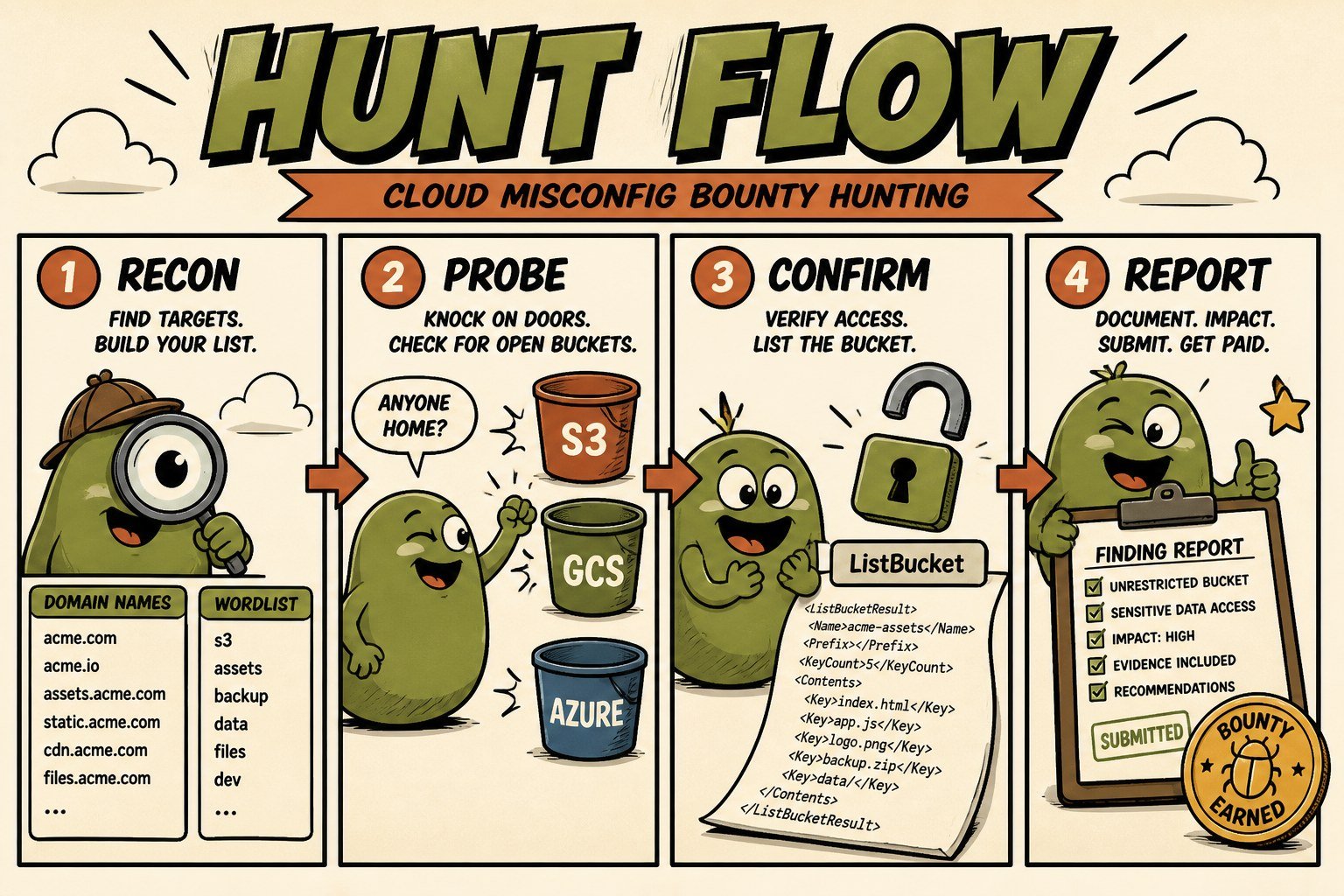
If you need more surface before guessing names, reuse the passive collection habits from our bug bounty recon workflow. JS files and mobile configs leak bucket hostnames constantly.
Scenario 1 - probe the wordlist until listings answer
In the demo lab, a tiny Python probe maps candidate names to local endpoints that speak the same XML dialects as the real clouds. On a real engagement you swap the lab map for the public URL patterns above.
cd /tmp/demo-cloud-lab
python3 scripts/probe-buckets.py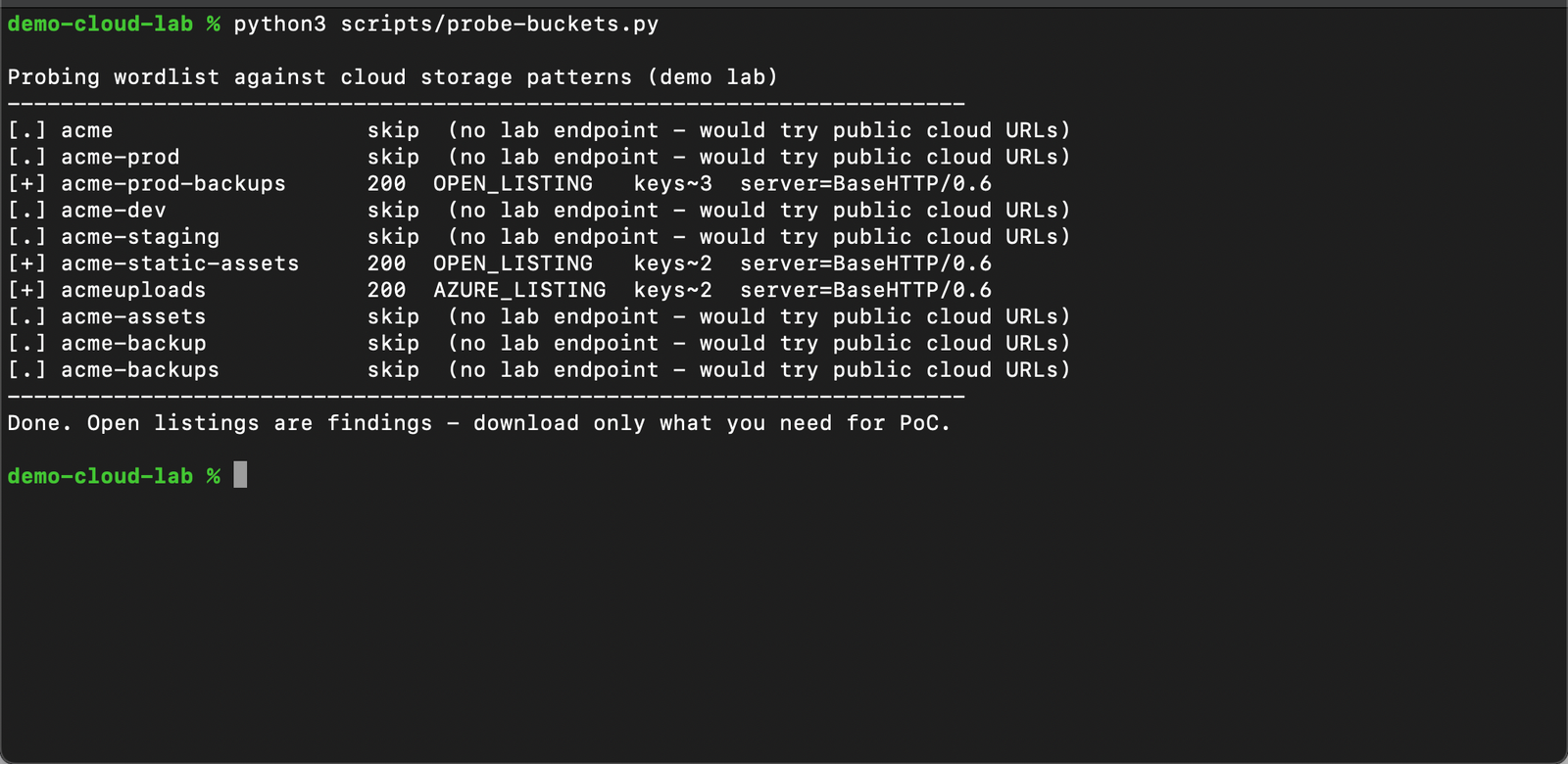
Three hits: open S3-style listing, open GCS-style listing, Azure container listing. That is your short list. Everything else stays a skip until recon gives you a better name.
Scenario 2 - confirm an open S3 listing and grab PoC
Never trust a tool banner alone. Pull the raw XML. You want <ListBucketResult>, a <Name>, and <Key> entries. Then fetch one object that proves impact.
curl -s http://127.0.0.1:8875/ | head -40
curl -s http://127.0.0.1:8875/secrets/.env.production | head -12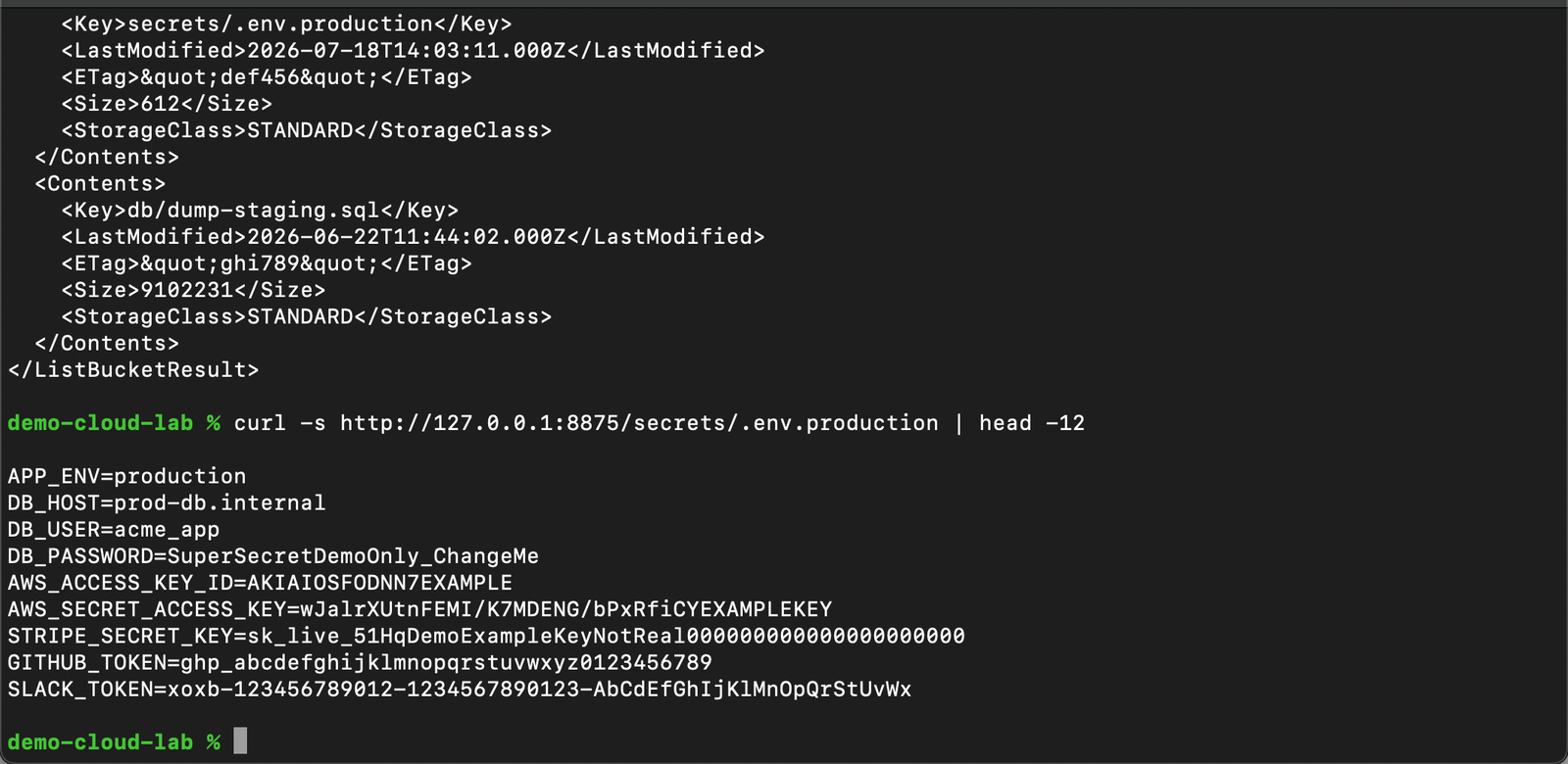
Keys like exports/users-*.csv, db/dump-*.sql, and secrets/.env.production are the difference between "public static assets" and a payout. On AWS you will also see Server: AmazonS3 and x-amz-request-id headers - keep those in the report.
Scenario 3 - let nuclei label the same signals
Once you have candidate hosts, nuclei is the boring confirmation layer. Public templates already know GCS listing (gcs-bucket-listing), Alibaba OSS listing, Firebase insecure DB, exposed .env, and more. In the lab we used matching custom templates pointed at localhost.
nuclei -t templates/ -l targets.txt -severity critical,high -silent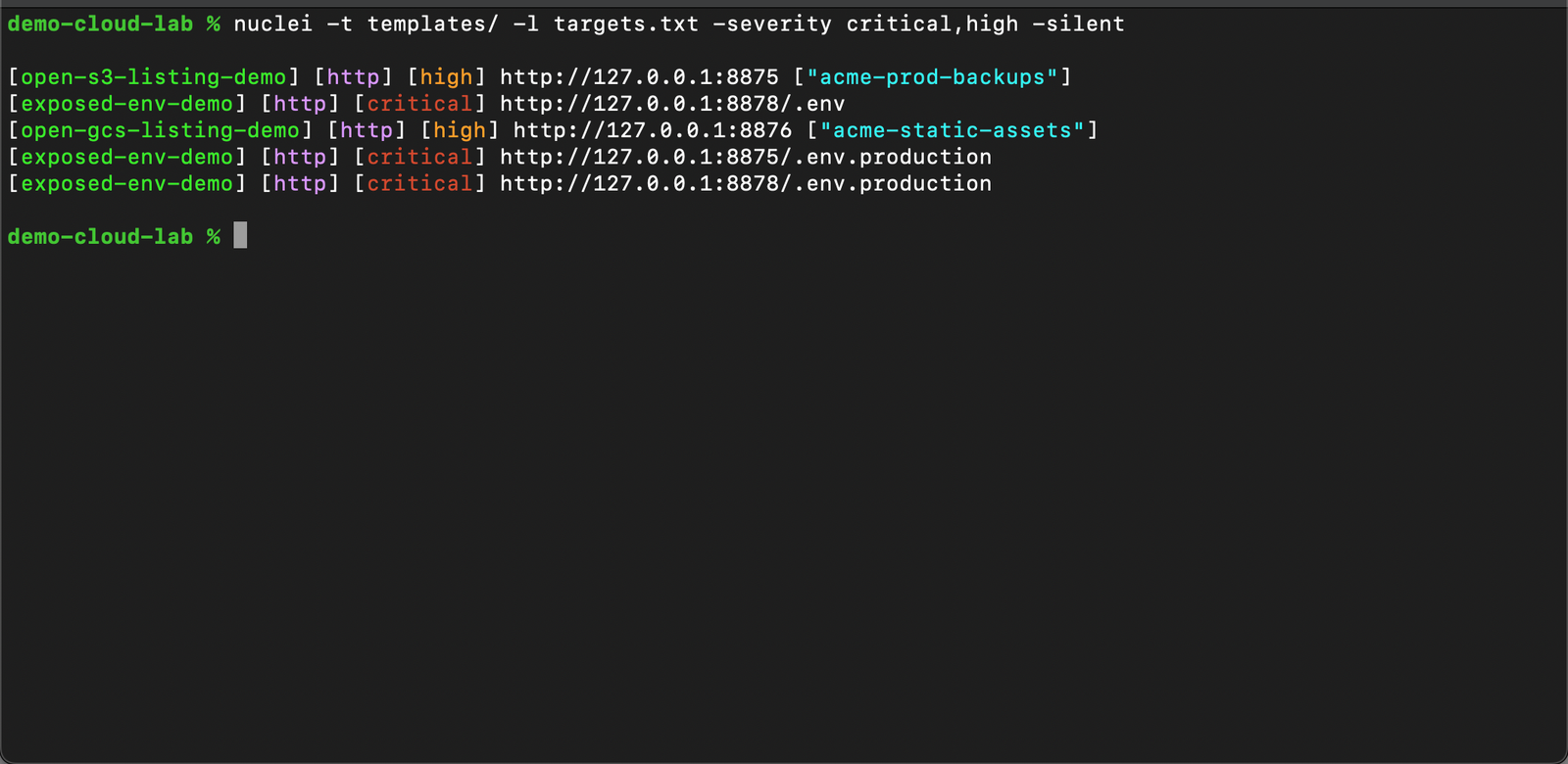
Critical env exposures plus high open listings in one pass. Save the JSON/SARIF if you batch programs - it beats screenshots of a GUI scanner.
Scenario 4 - open Firebase rules (the JSON dump)
When an Android/iOS/web app talks to *.firebaseio.com or a custom RTDB domain, try unauthenticated reads. The blunt check is still the best first move:
curl -s http://127.0.0.1:8877/.json | python3 -m json.tool | head -30
curl -s http://127.0.0.1:8877/users.json | python3 -m json.tool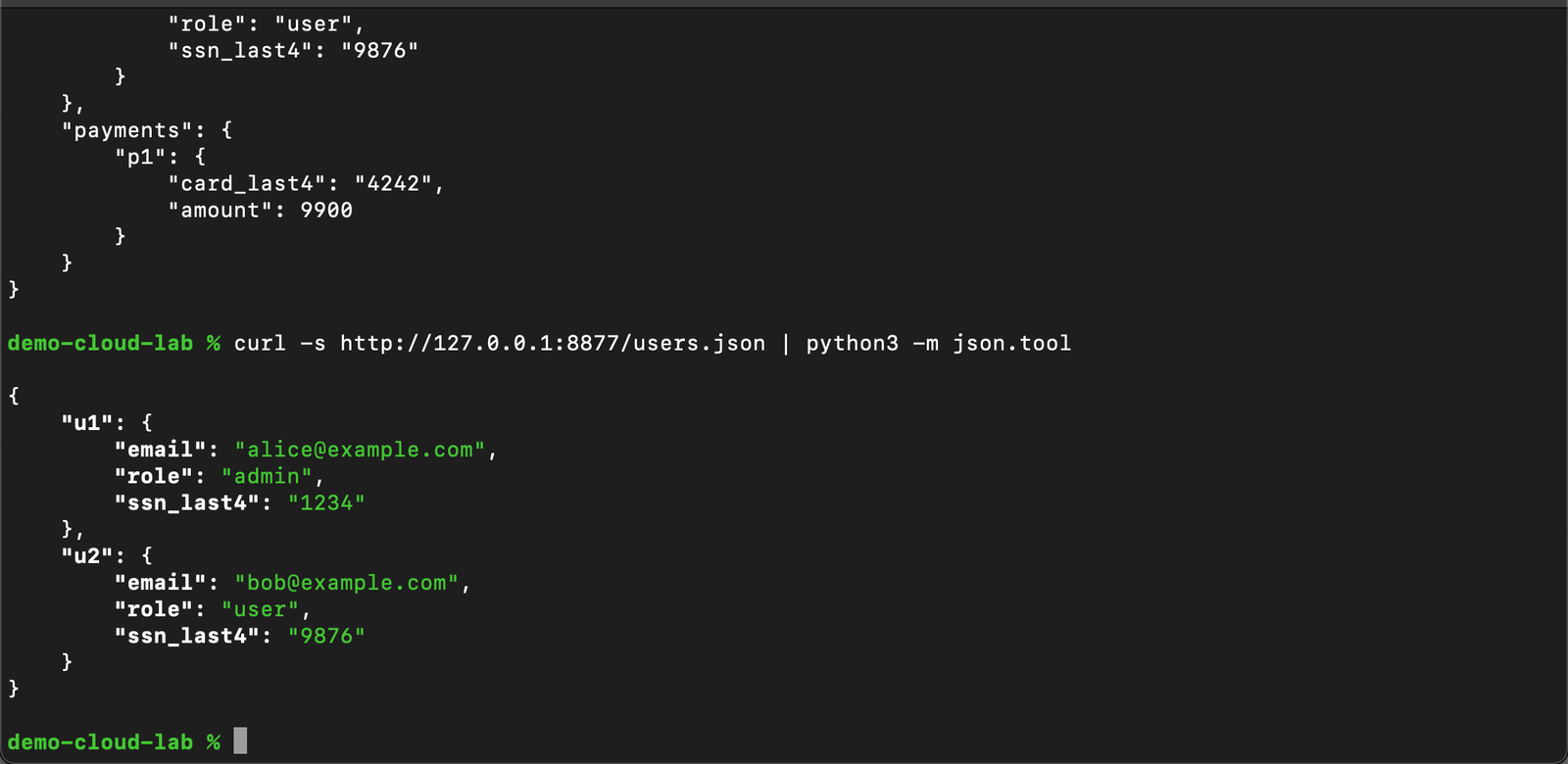
Emails, roles, payment fragments - that is impact. nuclei's insecure-firebase-database template also checks write by putting a canary key. Only do intrusive writes when the program allows it, and clean up after yourself.
Scenario 5 - scan dumped objects for keys that raise severity
An open listing of cat memes is meh. An open listing that contains .env.production with Stripe and Slack tokens is a different conversation. Dump the sensitive objects into a local folder, then run a secret scanner. We used gitleaks on the filesystem dump:
gitleaks detect --source bucket-dump --no-git --no-banner -v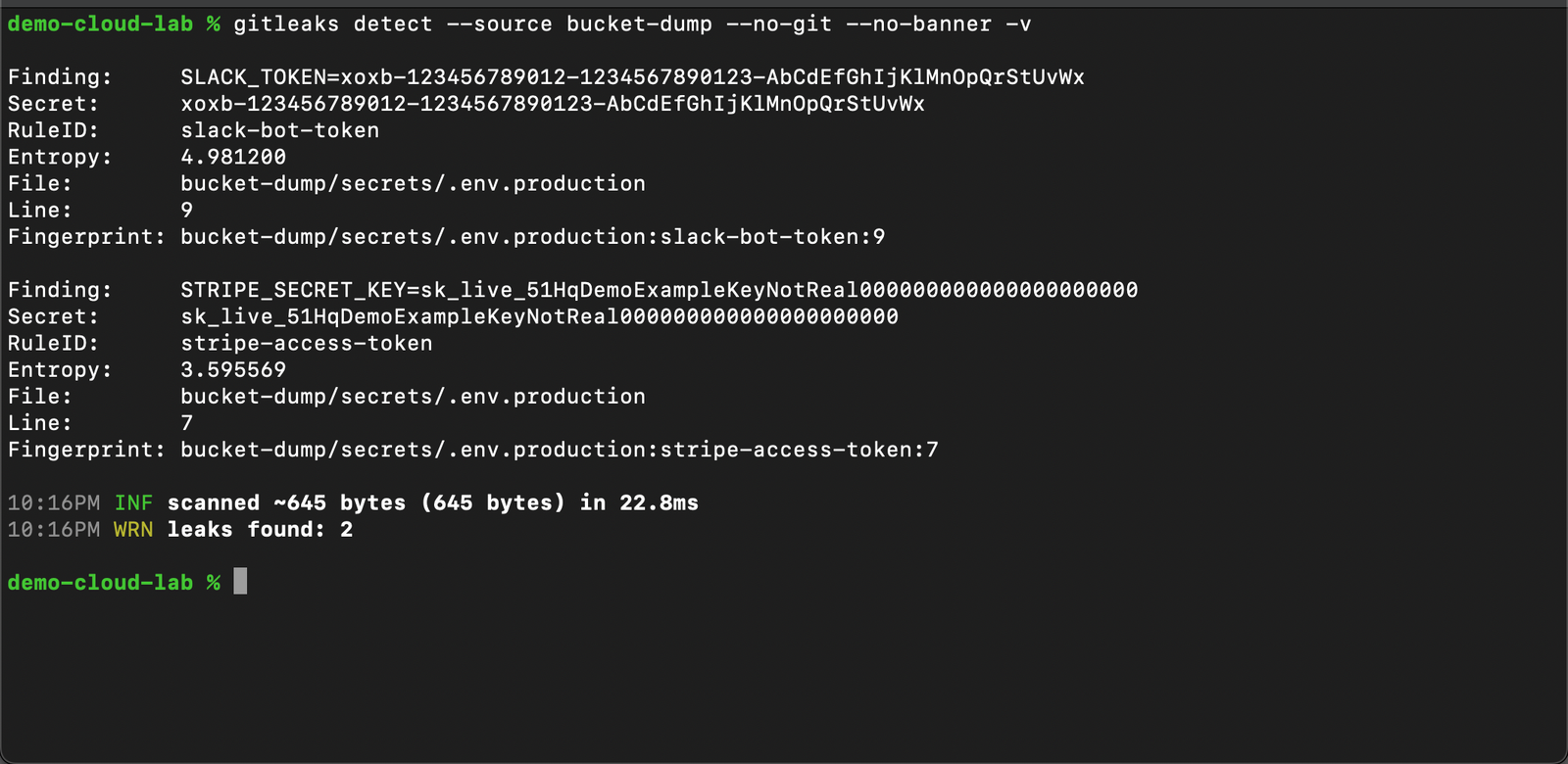
Two leaks in under a second: Slack bot token and Stripe live key. For verification workflows and automation, steal ideas from Secrets That Pay - verified beats regex noise every time. Still: finding a live key is not permission to spend it.
Scenario 6 - Azure public containers and the classic /.env
Azure hunters forget the query string. Anonymous list needs restype=container&comp=list. Pair that with boring web exposures on the same brand's static host.
curl -s "http://127.0.0.1:8878/public?restype=container&comp=list" | head -25
curl -s http://127.0.0.1:8878/.env | head -10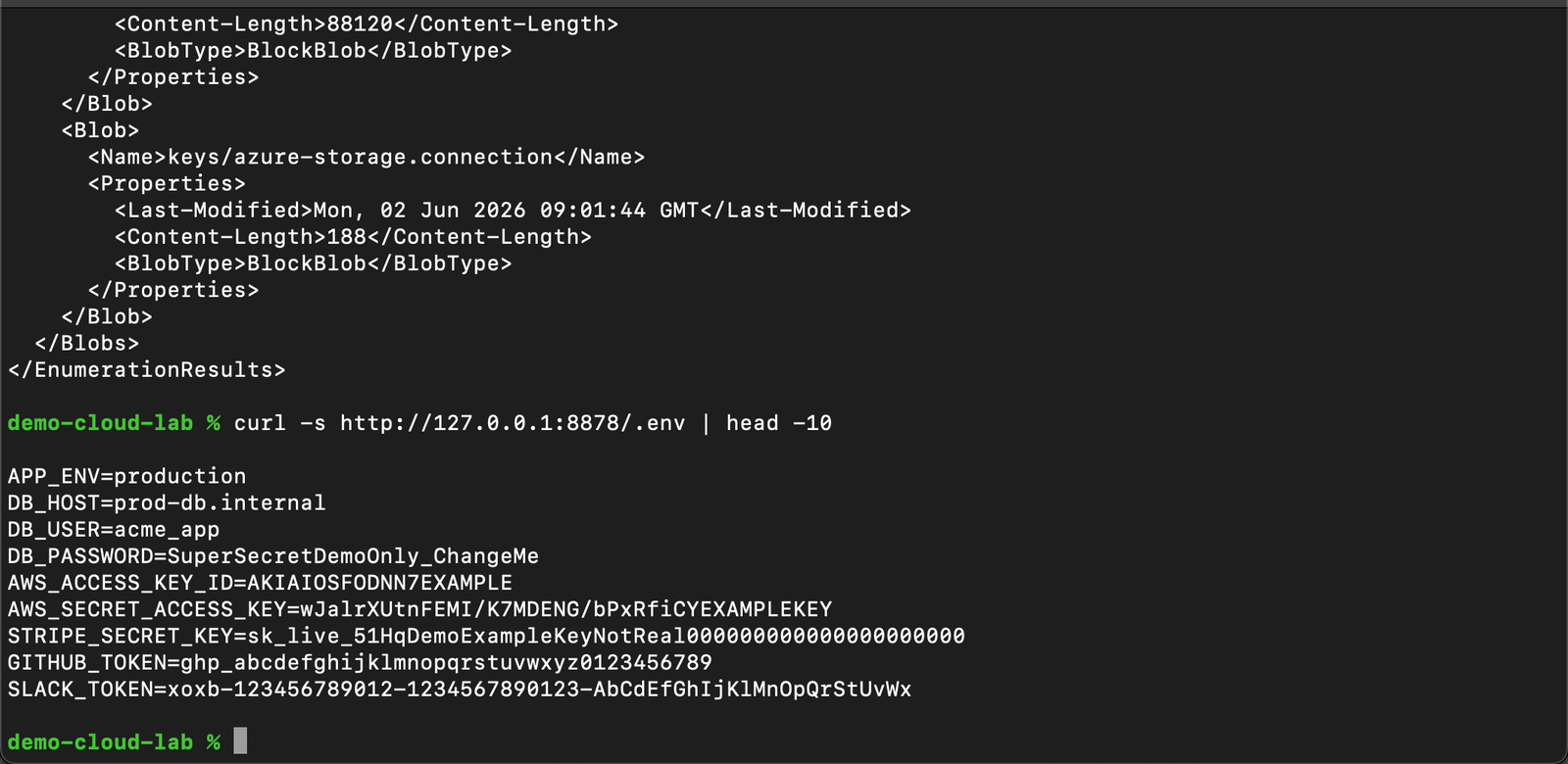
Invoices plus a connection-string object in the container, and a public .env on the site in front of it. That combo is how "low CDN bucket" turns into "credential + financial data" in one afternoon.
# 1) Build scoped names from recon
# 2) Probe public storage URL patterns
while read -r name; do
  code=$(curl -s -o /tmp/b.xml -w "%{{http_code}}" "https://${{name}}.s3.amazonaws.com/")
  if grep -q ListBucketResult /tmp/b.xml 2>/dev/null; then
    echo "[+] OPEN S3 $name ($code)"
  fi
done < buckets.txt

# 3) Confirm + sample one object
curl -s "https://acme-prod-backups.s3.amazonaws.com/" | tee listing.xml | head
# fetch a single key from the listing for PoC only

# 4) nuclei pass on live hosts
nuclei -l live-storage.txt -tags exposure,misconfig,firebase,s3 -severity critical,high,medium -silent

# 5) secret triage on PoC dump
gitleaks detect --source ./poc-dump --no-git -v
# or: trufflehog filesystem ./poc-dump --results=verified
Keep rate limits polite. Public cloud endpoints will throttle you, and angry SOCs will too. Chain this with supply-chain thinking from our supply chain post when the bucket holds CI artifacts or signing material.
How to write the report so it gets paid
- Title: "Public S3 listing on acme-prod-backups exposes user exports and .env"
- Asset: exact hostname / bucket / Firebase URL
- Steps: unauthenticated GET, show XML/JSON, show one redacted object
- Impact: data class (PII, credentials, backups), not "cloud misconfig" fluff
- Remediation: block public ACLs, bucket policy deny, Firebase rules deny-by-default, rotate every leaked secret
If the program uses CVSS language, lean on confidentiality impact and scope change when credentials appear. Our CVSS helper is enough for a clean severity paragraph. For the overall hunting posture, stay inside the guardrails of the bug bounty playbook.
Mistakes that waste a weekend
- Downloading entire buckets "for analysis" - that is how you turn a finding into an incident.
- Reporting public marketing assets with no sensitive keys - expect Informative.
- Using a leaked AWS key to list other accounts or start instances - out of scope, sometimes criminal.
- Ignoring Azure query params and calling the container "secure" after a bare GET 400.
- Skipping secret scanning on dumps - you leave money on the table.
Wrap
Cloud misconfig hunting is not glamorous. It is wordlists, XML, and restraint. Run the probe, confirm the listing, grab a tiny PoC, scan for secrets, write a sharp report. That loop still pays in 2026 because teams keep shipping backup buckets and Firebase rules like it is 2018.
FAQ
Is guessing bucket names allowed in bug bounty?
Only inside written scope. Many programs allow passive checks against public cloud endpoints tied to the brand. Mass scanning unrelated tenants, downloading whole buckets, or using leaked keys to access customer data is usually out of scope and can get you banned.
What is enough proof for an open bucket report?
HTTP 200 with ListBucketResult (or Azure EnumerationResults), the bucket/container name, a short sample of object keys, and one redacted sensitive object if it exists. Do not attach full dumps of PII.
Open listing but only public CSS - still a finding?
Often informational or low unless write is also open. Severity jumps when objects include backups, exports, .env, keys, or personal data. Say what you could read and what impact that creates.
Firebase open rules vs a public marketing site?
If /.json returns user or payment records without auth, that is a high-impact misconfig. A public landing page is not. Prove data sensitivity with a tiny redacted sample.
Which tools should I run first?
Start with a scoped wordlist + curl against S3/GCS/Azure URL patterns, then nuclei templates for listings and exposed configs, then gitleaks or TruffleHog on any objects you pulled for PoC. Recon feeds the wordlist - see our bug bounty recon workflow.
Can I use leaked AWS keys I found in a bucket?
Treat live cloud keys as a finding. Do not use them to browse customer data or spin up resources. Document the key type, a safe whoami/list check if the program allows, then revoke guidance for the vendor. Pair with our Secrets That Pay post for verification hygiene.