
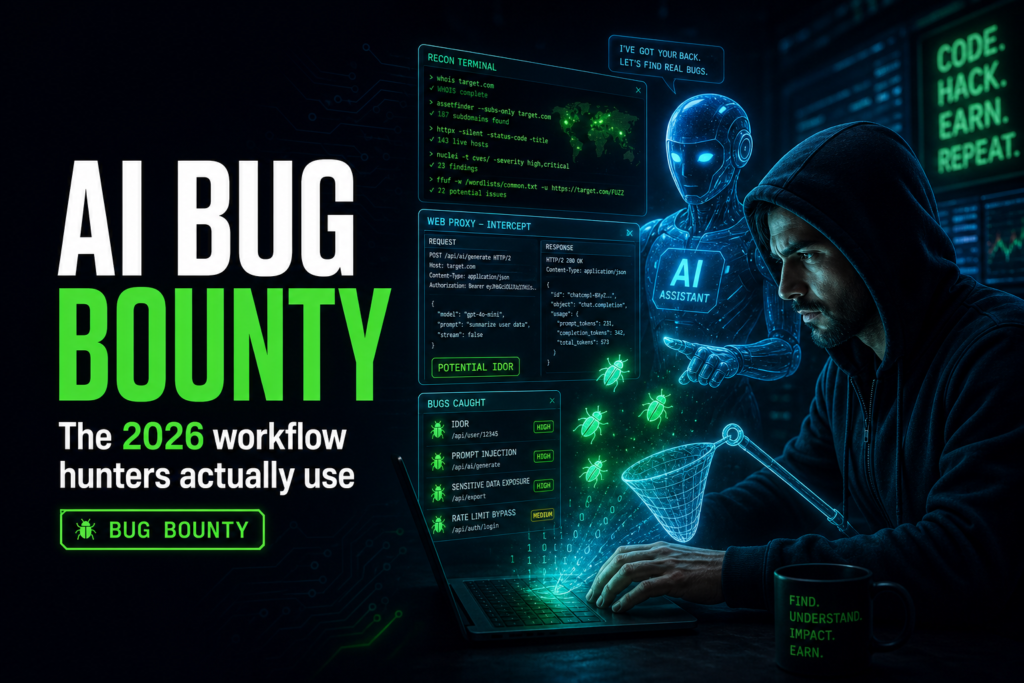
Let's clear something up before the hype machine runs away with it: AI is not going to win you a bug bounty while you sleep. What it will do - if you wire it up properly - is take the slow, boring 80% of hunting off your plate so you can spend your time on the part that actually pays, which is creative exploitation. That is what a real AI bug bounty workflow looks like in 2026, and this is the honest, hype-free version of how the good hunters are running it.

The short version (TL;DR)
- An AI bug bounty workflow is not "AI finds bugs for you." It is a pipeline where automation handles recon, AI handles analysis and grunt work, and you handle the creative exploitation and chaining.
- The real stack: continuous recon automation, AI-assisted JavaScript and code review, AI vulnerability hypotheses from request/response pairs, and AI-drafted reports - usually with Claude Code or similar plugged into Burp Suite over MCP.
- The honest numbers matter. In one study an AI agent solved 9 of 10 lab challenges for the price of a coffee, but a separate test of AI scanning hit an 86% false-positive rate. AI is a force multiplier, not an oracle.
- Humans still win on business logic, scope intuition, and multi-step chaining - which is exactly where the big payouts live.
- Used carelessly, AI gets you duplicate-spamming reputation damage and blown scope. Used well, it roughly doubles how much ground you can cover.
What "AI bug bounty" actually means
There is a fantasy version of this where you type a domain into a chatbot and critical findings fall out. That is not the job. Traditional hunting is mostly manual and mostly slow: you run recon, eyeball the results, poke endpoints one at a time. It works, but it does not scale, and most of your hours go into work that is not actually hard - just tedious.
The AI-augmented approach flips the ratio. Automation watches your targets and does the first pass of recon. AI reads the boring stuff - sprawling JavaScript bundles, repetitive request/response pairs - and surfaces the interesting bits. Then you, the human, do the thinking: deciding which lead is worth chasing, crafting the exploit, and chaining a couple of low-severity quirks into something that actually pays. The model is a tireless junior teammate. It is fast and cheap and occasionally brilliant, and it will also confidently hand you nonsense, so you never let it file the report unsupervised.
The modern AI-augmented pipeline
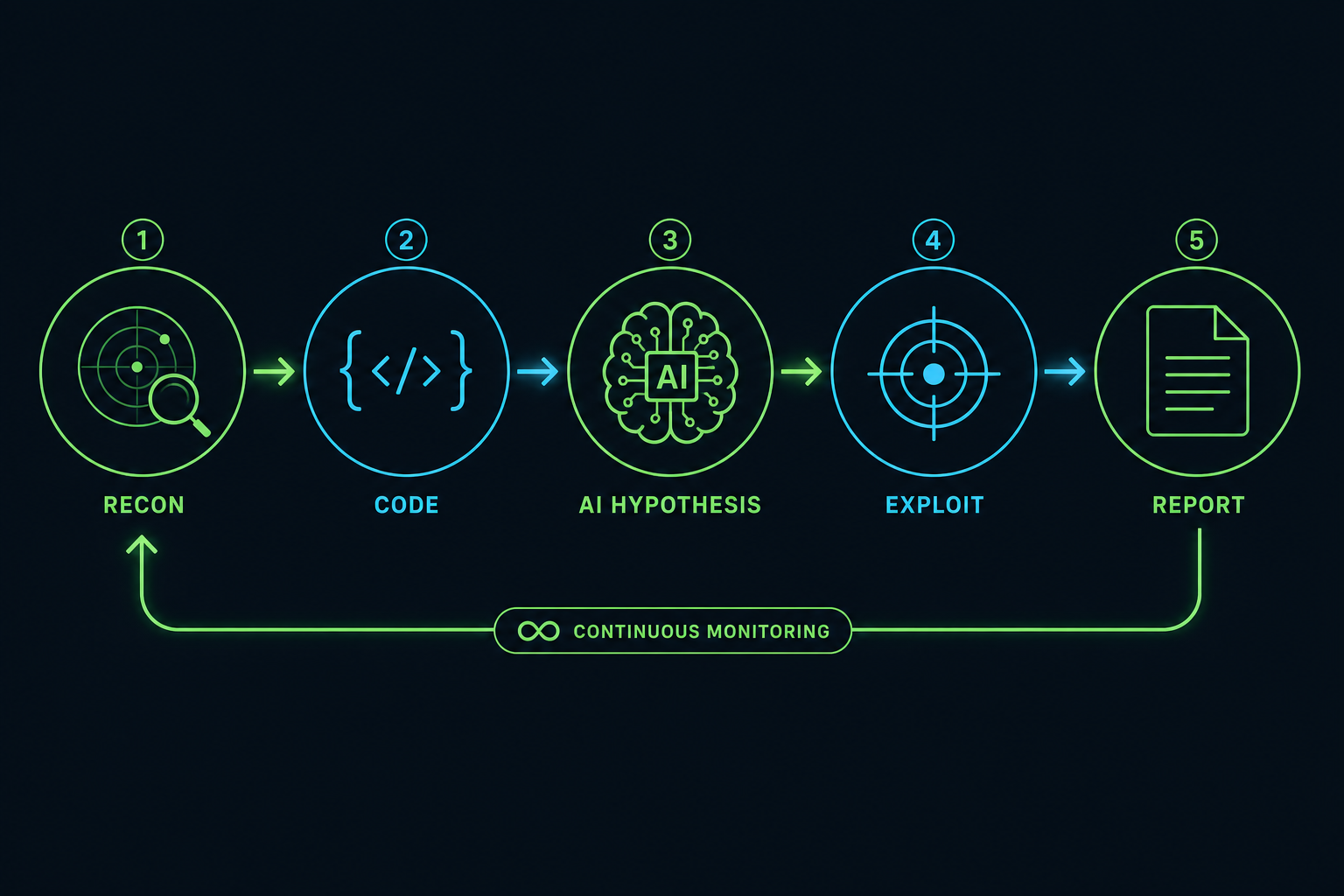
1. Continuous recon, not one-off recon
The biggest shift is that recon stops being a thing you "do" and becomes a thing that runs. A simple automation server (plenty of hunters use n8n or a few cron jobs) monitors your wildcard targets every few days, runs subdomain discovery, probes for live hosts with their tech stack and titles, diffs the results against the last baseline, and pings you only when something new appears. New attack surface lands in your inbox or Telegram the day it goes live, instead of whenever you next remember to look. If you are still building this muscle, start with our roundup of top recon tools for bug bounty hunters and automate from there.
2. AI-assisted JavaScript and code review
This is where AI earns its keep fastest. Modern apps ship enormous JavaScript bundles, and buried in them are forgotten endpoints, accepted parameters, hidden feature flags, and the occasional hardcoded secret. Reading all of that by hand is soul-crushing. Feed each crawled JS file through a model and ask it to extract endpoints, parameters, and anything that smells like a credential. You get a tidy list of things to throw at your proxy, instead of scrolling through minified spaghetti at 1 a.m.
3. AI vulnerability hypotheses from traffic
The slickest part of a 2026 AI bug bounty setup is connecting your proxy directly to the model. With a Burp Suite MCP connection, request/response pairs flow into the AI's context, and it suggests likely vulnerability classes, points at injection candidates, and drafts modified requests - no copy-pasting between windows. Treat its output as a ranked list of hypotheses to test, not a list of confirmed bugs. It is brilliant at "this endpoint looks like it could have an IDOR, try incrementing this ID" and useless at knowing whether the app's auth model actually allows it.
4. Human exploitation and chaining
This stage is still yours, and it is where the money is. Confirming a finding, understanding the business impact, and stitching two boring bugs into one critical chain takes context and creativity that models do not have. The data backs this up: the large majority of successful hunters say they prioritize business logic over purely technical bugs, precisely because that is the work AI cannot replicate. Let AI hand you the leads; you do the hunting.
5. AI-drafted reports (that you edit)
Once you have a confirmed bug, AI is genuinely great at the writeup: a clean reproduction, a clear impact statement, a sensible severity rating, and a remediation suggestion. Triagers move faster on reports that spell out impact precisely, and a well-articulated consequence sometimes nudges severity (and your payout) upward. Just read every line before you submit - never let a model invent an impact that is not really there. Pair it with the fundamentals in our guide to writing a killer pentest report.
The tools hunters are actually using
- Claude Code + Burp Suite MCP - the common backbone. The model reads your traffic and source, suggests payloads, and generates modified requests inside your testing loop. If you are new to the proxy side, our guide to Burp Suite is a good starting point.
- Kali MCP servers - connect your Kali toolbox to the agent so it can run and read tool output directly instead of you shuttling results back and forth.
- Automation platforms (n8n, custom scripts) - the engine behind continuous recon and change detection.
- Custom AI skills - purpose-built prompt skills for recon, payload generation, CVSS scoring, and report writing, loaded into the agent and applied per task. This is the real "secret weapon" most top hunters mention.
- Open-source agent toolkits - projects that bundle recon, vuln testing, a validation gate, and report generation into one autonomous loop. Useful, but only as good as the human reviewing the output.
The honest numbers (read this before you trust it)
Hype is the enemy of good security work, so here is the reality check. On the impressive side: in research by Wiz, a frontier model solved 9 out of 10 lab challenges modeled on real bug bounty submissions - including multi-step auth bypasses and SSRF to AWS metadata - at a cost of roughly one to ten dollars per success. That is genuinely remarkable.
On the sobering side: when Semgrep evaluated an AI agent against real open-source Python web apps, it logged a 14% true-positive rate and an 86% false-positive rate. Most findings needed human triage. Both things are true at once: AI can crack a hard, well-scoped problem cheaply, and it will also bury you in confident false alarms on messy real-world code. That gap is exactly why the human stays in the loop. The same "agents trust their inputs too much" weakness we covered in agentjacking applies to your own tooling: never auto-run what the model suggests.
Where AI helps and where it hurts
- Great at: summarizing huge JS files, generating wordlists and payload variations, spotting candidate injection points, scoring severity, and drafting clear reports.
- Bad at: understanding real business logic, judging whether a finding is actually exploitable in context, and knowing your program's scope and rules.
- Dangerous if you skip review: auto-submitting AI reports tanks your reputation with duplicates and false positives, and an over-eager agent can wander out of scope - which can get you banned, not paid.
A simple starter workflow
- Pick one or two wildcard targets you are allowed to test, and set up automated recon that diffs results every few days.
- Pipe newly discovered hosts and JS files through a model to extract endpoints, parameters, and secrets.
- Connect your proxy to the agent and let it propose vulnerability hypotheses on interesting requests.
- Manually validate the promising ones. Confirm impact, then look for a chain.
- Have the model draft the report, edit it hard for accuracy, and submit.
- Always re-read scope rules. AI does not know your program's boundaries - you do.
The takeaway
AI bug bounty hunting is not about replacing the hunter. It is about deleting the busywork so the hunter can do more of the work that machines cannot. The people pulling ahead in 2026 are not the ones who trust AI blindly - they are the ones who automate ruthlessly, verify everything, and keep their own judgment firmly in the driver's seat. Build the pipeline, stay skeptical of the output, and let the model carry the boring parts while you go find the bug that actually matters.
Frequently asked questions
Can AI find bugs on its own?
Sometimes, in clean lab-style conditions - one study saw 9 of 10 challenges solved autonomously. On messy real-world targets, accuracy drops sharply (false-positive rates above 80% have been measured), so AI works best as an assistant that proposes leads a human then verifies.
Is using AI allowed in bug bounty programs?
Usually yes for assistance, but always check each program's rules. Many platforms discourage or ban mass automated scanning and low-quality AI-generated reports. Use AI to work smarter, not to spam submissions.
What is the best AI bug bounty tool?
There is no single best tool. Most hunters combine a coding agent (like Claude Code) connected to Burp Suite via MCP, an automation platform for continuous recon, and custom prompt skills for recon, payloads, and reporting.
Will AI replace bug bounty hunters?
Not soon. AI handles repetitive analysis well but struggles with business logic, context, and creative chaining - the high-value skills. It changes how hunters work rather than replacing them.
Found this useful? Share it with a fellow hunter - and tell us in the comments which part of your workflow you've handed over to AI.