
This Vulnerability Explain post covers Business Logic flaws and Race Conditions. Unlike injection bugs, these exploit the rules of the application itself - the assumptions developers make about how features will be used. Scanners rarely find them, which makes them a favorite in bug bounty. Let's explore.
What is Business Logic Flaws?
Business Logic vulnerabilities are flaws in the design and workflow of an application that let attackers achieve unintended outcomes by using legitimate features in unexpected ways. Race Conditions are a related timing flaw where concurrent requests interfere with each other.
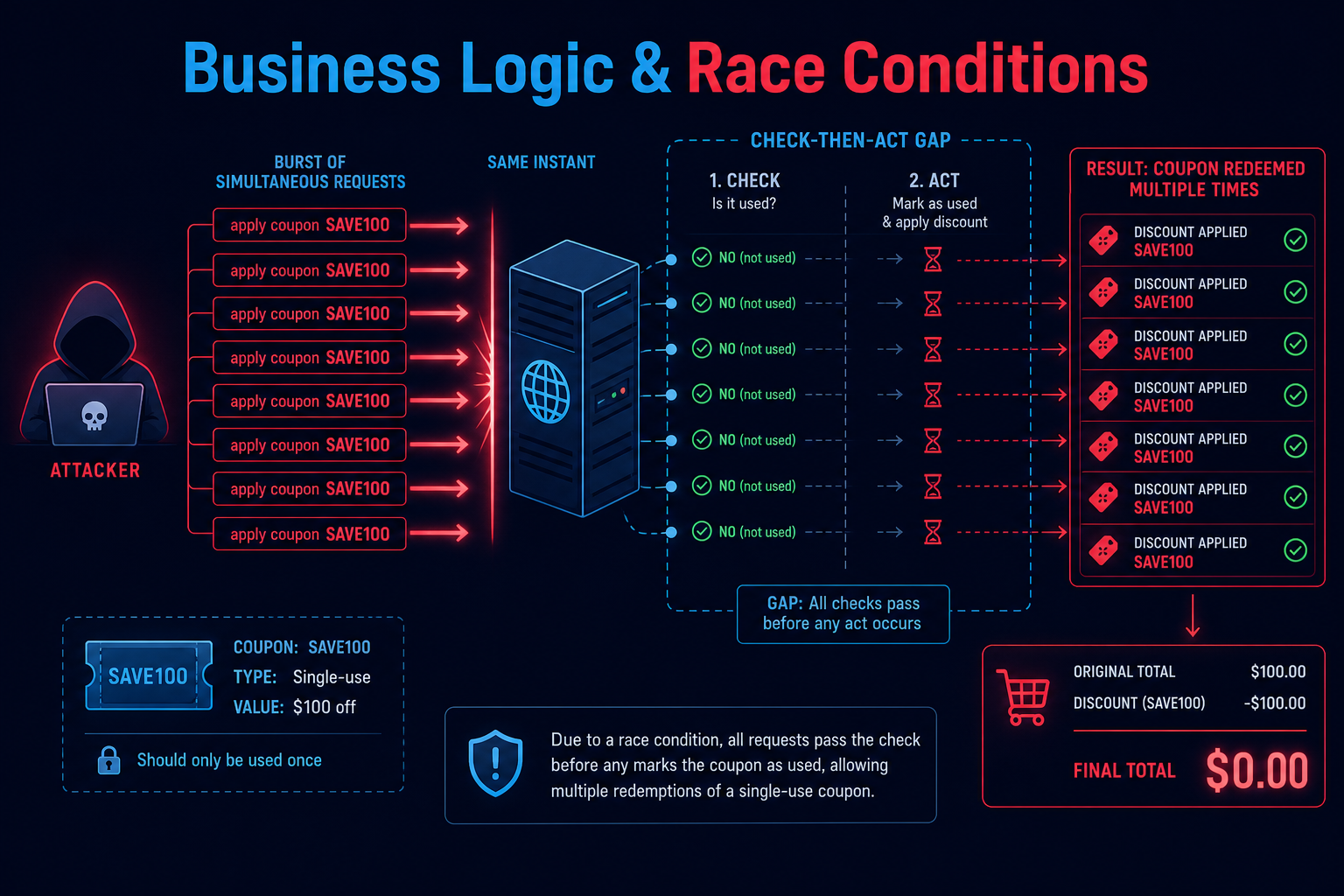
For example, a checkout that applies a discount before validating stock might let you buy items for free with a crafted sequence. A race condition might let you redeem a single-use coupon many times by firing dozens of requests at once, before the system records that it was used.
How does Business Logic Flaws work?
These flaws exploit assumptions and timing rather than technical injection:
- Implicit Assumptions
- The app assumes steps happen in order, values stay in range, or features are used as intended.
- Workflow Manipulation
- The attacker skips steps, replays requests, or supplies edge-case values the design never anticipated.
- Concurrency (Race)
- Many requests are sent simultaneously to hit a window between a check and the action it guards.
- State Inconsistency
- The system reaches a state the designers believed impossible, such as a negative balance or reused token.
- Impact
- Outcomes include financial loss, privilege gains, and bypassed limits.
Logic and race flaws are about the gap between what the code allows and what the business intends. Closing that gap means validating state and handling concurrency deliberately.
Tools and Techniques for Business Logic Flaws Testing
Finding these is mostly manual reasoning, with tooling to send precisely-timed requests.
Manual Testing Methodologies
- Workflow Mapping - Diagram each multi-step process and ask what happens if steps are skipped, repeated, or reordered.
- Value Abuse - Test negative numbers, zero, huge values, and currency or quantity edge cases.
- Replay and Reuse - Replay one-time actions like coupons, transfers, or tokens.
- Concurrency Testing - Fire many simultaneous requests to exploit check-then-act windows.
Automated Scanning Tools
- Burp Repeater with the single-packet attack - Sends requests in parallel to trigger races.
- Burp Intruder - Automates value abuse and rapid replay.
- Turbo Intruder - Specialized for high-rate and race-condition testing.
- ffuf - Helps with rapid concurrent request testing.
Business Logic Flaws Protection Mechanisms
Best Practices for Secure Coding
- Enforce State Server Side
- Description: Validate the full workflow state and invariants on the server at each step.
- Benefits: Skipped or reordered steps are rejected.
- Implementation Tip: Never trust client-side sequencing or hidden state.
- Handle Concurrency Safely
- Description: Use locks, atomic operations, or database constraints around critical sections.
- Benefits: Closes check-then-act race windows.
- Implementation Tip: Use atomic updates or unique constraints for one-time actions.
- Validate Business Rules
- Description: Enforce limits, ranges, and ownership for every value and action.
- Benefits: Edge-case abuse fails.
- Implementation Tip: Re-validate amounts, quantities, and entitlements server side.
Best Practices for Organizations
- Threat Modeling
- Threat model each feature's workflow during design.
- Ask how each step could be abused.
- Idempotency and Limits
- Design sensitive actions to be idempotent.
- Apply rate limits and quotas.
- Testing
- Include logic and concurrency abuse cases in QA.
- Pentest high-value workflows specifically.
Top Business Logic Flaws payloads used by Security Researchers
As a security researcher, knowing the most common payloads helps you detect and prevent these attacks. Use this knowledge ethically and only on systems you are authorized to test. Some sample payloads are shown below.
// Race condition: redeem one coupon many times (concurrent)
// 50x in parallel:
POST /cart/apply-coupon  { "code": "SAVE100" }
// Negative quantity to invert a charge
POST /cart/add { "item": 9, "qty": -5 }// Skipping a workflow step
// jump straight to confirm without payment:
POST /order/confirm { "orderId": 1234 }// Replaying a one-time transfer request
POST /transfer { "to": "attacker", "amount": 100 } // sent repeatedlyReal-World Example: Coupon Redeemed 50 Times
A shop let users apply a one-time discount code. The code checked whether the coupon was used, then marked it used as a separate step - a classic check-then-act gap.
An attacker sent fifty apply-coupon requests at the same moment. All fifty passed the "is it used?" check before any of them recorded the usage, so the single-use coupon stacked fifty times and the order total dropped to nothing.
The fix used an atomic database update that marked the coupon used and applied it in one step, rejecting concurrent reuse. Logic and race flaws hide in the spaces between steps - close those spaces with server-side state and atomic operations.
Vulnerable and secure code of Business Logic Flaws
The following example shows the contrast between vulnerable and secure code for Business Logic Flaws. It helps you see how the flaw creeps into real code and the changes that shut it down.
🥺 Vulnerable Code:
# Vulnerable: check-then-act leaves a race window
def apply_coupon(user, code):
    coupon = db.get_coupon(code)
    if coupon and not coupon.used:        # check
        discount = coupon.value
        coupon.used = True                # ...act (separate step)
        db.save(coupon)
        return apply_discount(user, discount)
raise Exception("Invalid or used coupon")- Many concurrent requests pass the not-used check before any marks it used.
- A single-use coupon can be redeemed many times in the race window.
😎 Secure Code:
# Secure: atomic update closes the race window
def apply_coupon(user, code):
    # Mark used and fetch in ONE atomic operation;
    # only one request can succeed.
    rows = db.execute(
        "UPDATE coupons SET used = TRUE "
        "WHERE code = %s AND used = FALSE RETURNING value",
        (code,),
    )
    if not rows:
        raise Exception("Invalid or used coupon")
return apply_discount(user, rows[0].value)- The atomic UPDATE … WHERE used = FALSE lets only one request win.
- There is no gap between the check and the act, so concurrency cannot abuse it.
Conclusion
Business Logic and Race Condition flaws are the bugs scanners miss, because the code is doing exactly what it was told - just not what the business meant. Enforce workflow state and business rules on the server, handle concurrency with atomic operations or locks, make sensitive actions idempotent, and threat model every feature. The strongest defense is asking, for each step, how someone might abuse it.