
This Vulnerability Explain post covers Application-level Denial of Service (DoS). Unlike volumetric network floods, application DoS uses small, clever requests that trigger expensive work on the server - exhausting CPU, memory, or other resources with minimal effort. Let's look at how it happens and how to defend.
What is Application DoS?
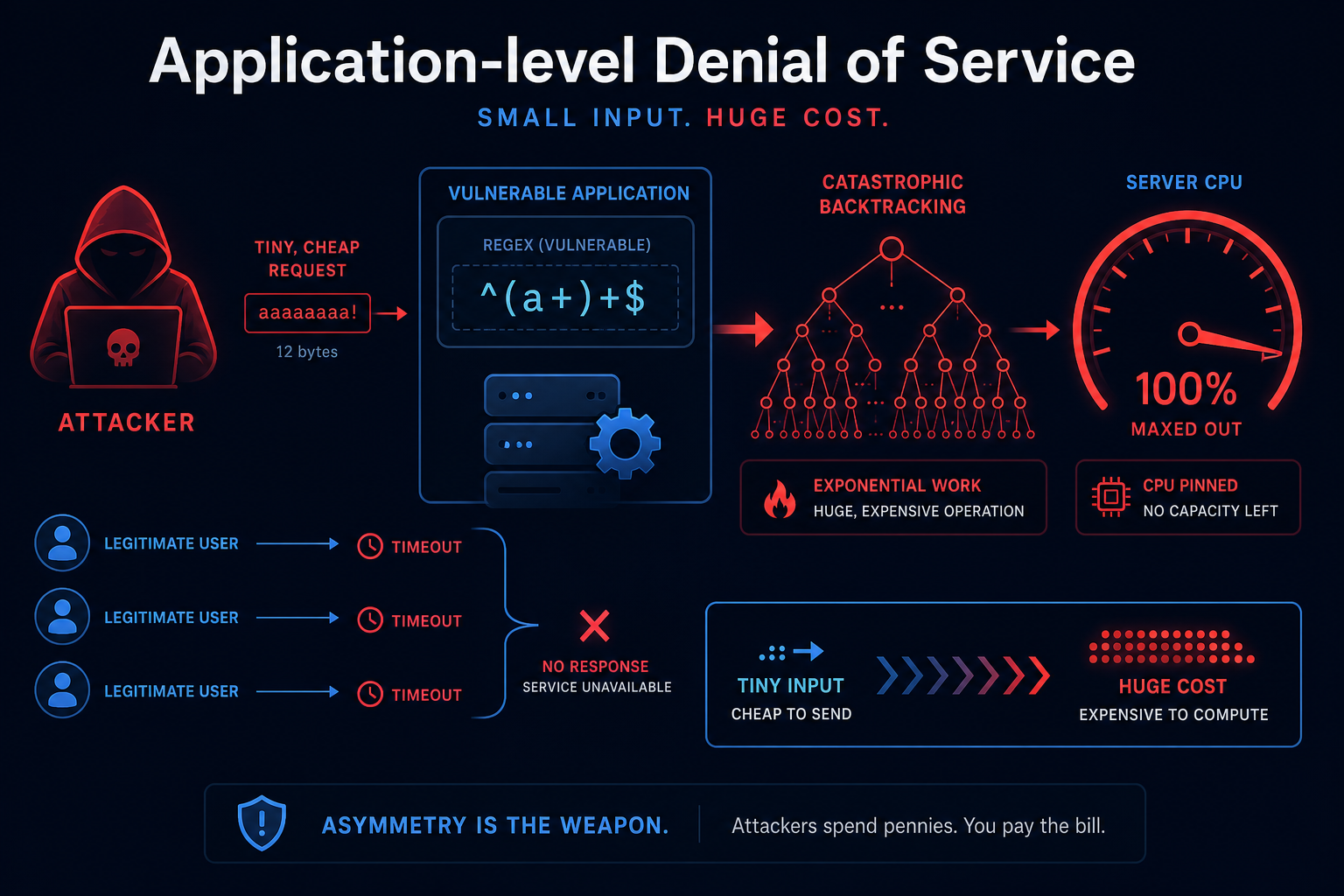
Application-level DoS is an attack that makes an application unavailable by abusing its own logic to consume disproportionate resources, rather than overwhelming the network with sheer traffic. A handful of crafted requests can be enough.
Examples include an unbounded search that scans huge datasets, a regular expression that blows up on certain input (ReDoS), an export feature that builds enormous files, or a password-hashing endpoint hit repeatedly. The attacker spends little; the server spends a lot.
How does Application DoS work?
Application DoS turns cheap requests into expensive work:
- Expensive Operation Identified
- The attacker finds functionality that consumes significant CPU, memory, time, or storage.
- Amplification
- A small request triggers disproportionately large work, for example a catastrophic regex or a huge data export.
- Resource Exhaustion
- Repeated or crafted requests consume server resources faster than they are freed.
- Service Degradation
- Legitimate users experience slowdowns, timeouts, or full unavailability.
- Sustained Impact
- With little cost, the attacker keeps the service degraded or down.
Application DoS is about asymmetry: tiny input, huge cost. Removing that asymmetry with limits and efficient design is the core defense.
Tools and Techniques for Application DoS Testing
Testing identifies expensive operations and measures resource cost per request.
Manual Testing Methodologies
- Expensive Endpoint Mapping - Identify search, export, report, and computation-heavy features.
- ReDoS Probing - Test regex-backed inputs with pathological strings that cause exponential backtracking.
- Resource Measurement - Measure response time and resource use as input size grows.
- Limit Testing - Send large payloads, deep nesting, or many items to find missing bounds.
Automated Scanning Tools
- Nuclei - Templates detect some DoS and ReDoS patterns.
- regexploit - Finds regular expressions vulnerable to ReDoS.
- Apache JMeter - Load tests to measure resource cost under request volume.
- Burp Suite Scanner - Helps surface expensive or unbounded operations.
Application DoS Protection Mechanisms
Best Practices for Secure Coding
- Bound Every Operation
- Description: Enforce limits on input size, result counts, recursion, and processing time.
- Benefits: Removes the asymmetry attackers exploit.
- Implementation Tip: Paginate results and cap payload sizes and nesting depth.
- Avoid Catastrophic Patterns
- Description: Use safe, linear-time regular expressions and efficient algorithms.
- Benefits: Prevents ReDoS and algorithmic blowups.
- Implementation Tip: Test regexes for backtracking and prefer vetted libraries.
- Apply Rate Limiting and Timeouts
- Description: Rate-limit requests and set strict timeouts on expensive work.
- Benefits: Caps how much damage repeated requests can do.
- Implementation Tip: Use per-user and per-endpoint limits plus circuit breakers.
Best Practices for Organizations
- Capacity and Quotas
- Apply quotas for resource-heavy features.
- Isolate expensive workloads from core request handling.
- Edge Protections
- Use a WAF and rate limiting at the edge.
- Auto-scale with sensible upper bounds.
- Testing
- Load test critical endpoints.
- Add resource-cost checks to performance and security reviews.
Top Application DoS payloads used by Security Researchers
As a security researcher, knowing the most common payloads helps you detect and prevent these attacks. Use this knowledge ethically and only on systems you are authorized to test. Some sample payloads are shown below.
// ReDoS - pathological input for a vulnerable regex
// regex: ^(a+)+$
input: aaaaaaaaaaaaaaaaaaaaaaaaaaaaaaaa!
// Unbounded result request
GET /api/search?q=&limit=1000000// Deeply nested JSON to exhaust the parser
{ "a": { "a": { "a": { "a": { "a": "..." } } } } }// Repeatedly hitting an expensive endpoint
POST /api/report/generate (huge date range), sent rapidlyReal-World Example: One Regex Brings Down the API
An API validated a user-supplied field with the regular expression ^(a+)+$, a classic ReDoS-prone pattern, on every request.
An attacker submitted a long string of 'a' characters ending in a non-matching character. The regex engine entered catastrophic backtracking, pinning a CPU core for many seconds per request. A few concurrent requests saturated the servers and the whole API became unresponsive for everyone.
The fix replaced the regex with a safe, linear pattern, added input length limits, and applied rate limiting. Application DoS is won by removing asymmetry - never let a tiny request buy an attacker enormous server-side cost.
Vulnerable and secure code of Application DoS
The following example shows the contrast between vulnerable and secure code for Application DoS. It helps you see how the flaw creeps into real code and the changes that shut it down.
🥺 Vulnerable Code:
// Vulnerable: ReDoS-prone regex with no input bounds
app.post("/validate", (req, res) => {
  const value = req.body.value;
  // Catastrophic backtracking on input like "aaaa...aaa!"
  const ok = /^(a+)+$/.test(value);
  res.json({ valid: ok });
});- The nested-quantifier regex backtracks exponentially on crafted input.
- A single small request can pin a CPU core and starve other users.
😎 Secure Code:
// Secure: safe pattern, input limits, and rate limiting
const rateLimit = require("express-rate-limit");
app.use("/validate", rateLimit({ windowMs: 60_000, max: 30 }));

app.post("/validate", (req, res) => {
  const value = String(req.body.value || "");
  if (value.length > 256) return res.status(413).send("Too long");
  // Linear-time check, no nested quantifiers
  const ok = /^a+$/.test(value);
  res.json({ valid: ok });
});- The linear regex and length cap remove the catastrophic backtracking.
- Rate limiting bounds how often the endpoint can be hit.
Conclusion
Application-level DoS wins on asymmetry: a tiny, cheap request that forces enormous server-side work. Bound every operation with size, count, depth, and time limits, avoid catastrophic regexes and algorithms, apply rate limiting and timeouts, and isolate heavy workloads. When no small request can buy a large cost, application denial of service has nothing to exploit.